Hilton bedding may look simple, but sourcing it is rarely as easy as choosing a thread count. Buyers can face different specifications across hotel tiers, brands, and markets. If they select the wrong construction or an inconsistent factory, guest comfort and laundry costs can suffer. We help buyers match the right specification with reliable production.
Hilton bedding comes from approved manufacturers that can meet the specification for a particular brand, property, and contract. Hotelier is one manufacturer with direct Hilton order experience. Since 2022, we have produced Hilton orders at monthly volumes exceeding 20,000 sets, including common 250TC and 300TC cotton‑polyester constructions. However, no single specification applies to every Hilton property.

The more useful question is not only who makes the product. We believe buyers should ask whether a supplier can reproduce an approved sample, control every production stage, and maintain the same quality across thousands of sets and future repeat orders.
Publication note: We recommend confirming that the Hilton relationship, order history, monthly volumes, and on‑site personnel arrangement are cleared for public disclosure before publishing this article.
Who Actually Supplies Hilton Bedding?
Hotel buyers sometimes expect one global factory to supply every Hilton property. That assumption can lead to misleading “Hilton same” product claims. Hilton operates multiple brands across many markets, so its hotels may buy through approved manufacturers, project suppliers, distributors, or regional procurement programs.
Hilton bedding is supplied by qualified hotel‑linen manufacturers that produce according to approved specifications, samples, and purchasing contracts. Hotelier has direct Hilton production experience, but we are not the only supplier worldwide. The selected factory and product construction can vary by Hilton brand, hotel tier, location, project budget, and operating requirements.

A Supplier Must Follow the Project Specification
In our experience, a hotel group does not simply order “good white sheets.” Its procurement team may define several technical details, including:
- Fiber composition
- Thread count
- Yarn size
- Fabric weave
- Finished fabric weight
- Whiteness and shade tolerance
- Shrinkage limits
- Pillowcase and duvet‑cover construction
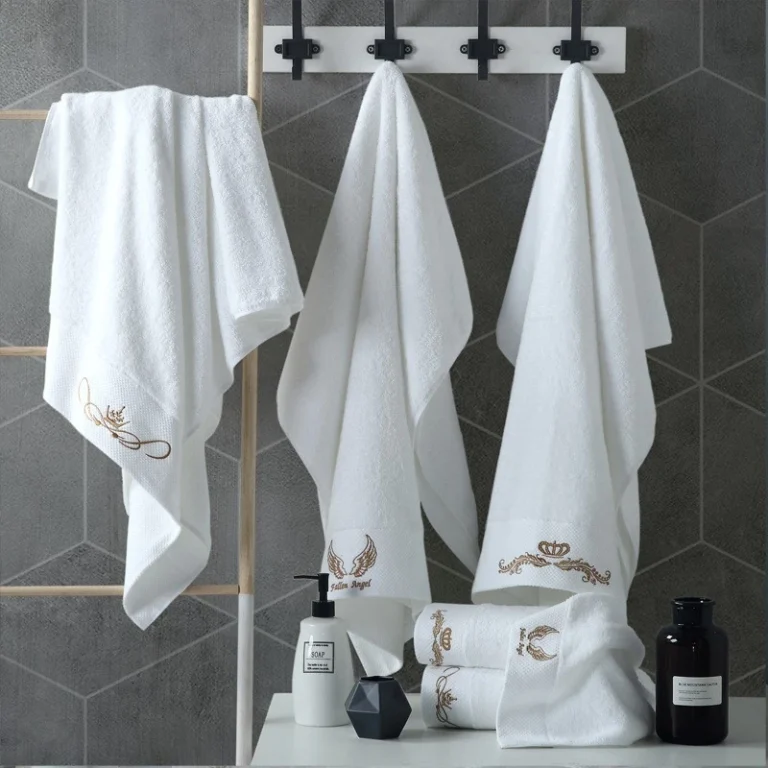
- Embroidery or decorative borders
- Labeling and packaging
- Wash‑performance requirements
A factory must translate those requirements into stable bulk production. A sample can look excellent because a sample room gives it special attention. The real test begins when the order reaches tens of thousands of sets.
Hotelier has handled Hilton orders since at least 2022. Our monthly order volume has exceeded 20,000 bedding sets for relevant projects. Hilton personnel have also worked on‑site at our factory as part of production and quality coordination. This arrangement helps both sides identify problems before products reach the hotel.
We Control More Than the Final Sewing
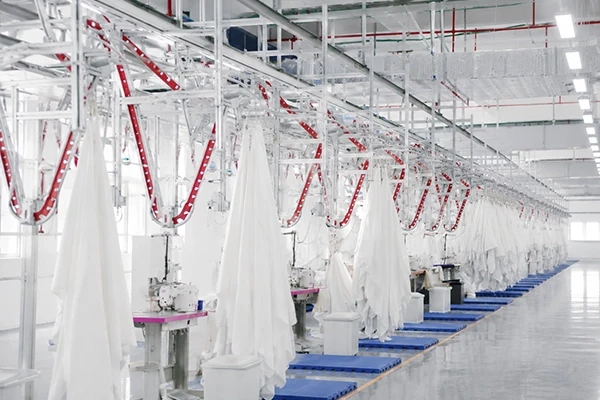
We have learned that sewing is only one part of consistency. We monitor the process from dyeing and fabric production through cutting, stitching, inspection, packaging, and bulk delivery.
For example, two fabric batches can technically use the same fiber blend and thread count but still feel different. Changes in yarn quality, weaving tension, finishing, or dyeing can affect softness, shade, shrinkage, and durability. These differences become obvious when hotels combine replacement linen with earlier deliveries.
I once saw a technically acceptable fabric lot rejected during an internal review because its white shade did not match the approved reference closely enough. The difference looked small in isolation, but it became clear when we placed the products side by side. That experience reinforced a simple point: repeat‑order consistency matters as much as the first sample.
What Hilton Bedding Specifications Are Common?
Buyers often focus on the highest available thread count. However, a high number does not automatically create better hotel bedding. If a specification does not suit the hotel’s positioning, laundry system, or replacement budget, it can increase costs without improving the practical guest experience.
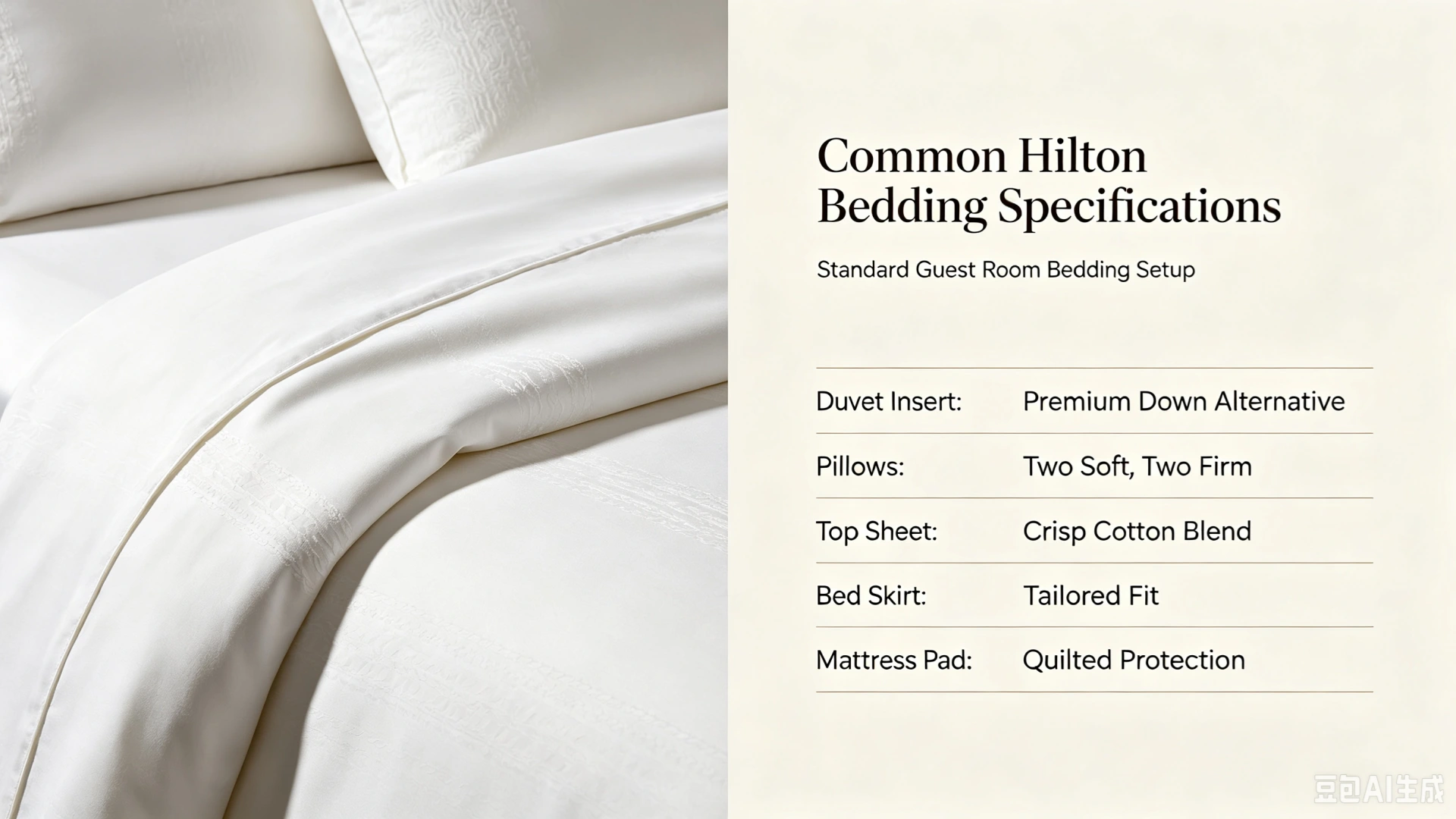
Based on our direct project experience, many business‑oriented Hilton properties use 250TC or 300TC bedding. Some higher‑end properties may require 400TC or above, along with customized details such as embroidered borders. These figures are project observations rather than a universal standard for every Hilton brand, region, or hotel.
Thread Count Is Only One Factor
Thread count describes the number of threads woven into one square inch of fabric. It can help buyers compare products, but it does not reveal the complete quality level.
We recommend evaluating the following factors together:
| Factor | Why It Matters in a Hotel |
| Thread count | Influences fabric density and hand feel |
| Fiber composition | Affects softness, strength, drying, and cost |
| Yarn quality | Influences smoothness, pilling, and durability |
| Weave and finishing | Affect breathability, sheen, and touch |
| Fabric weight | Changes handling, drying time, and guest perception |
| Shrinkage control | Protects dimensions after commercial washing |
| Sewing construction | Reduces seam failure and distortion |
| Shade consistency | Keeps replacement linen visually uniform |
| Wash performance | Determines useful life and operating value |
A well‑made 250TC cotton‑polyester sheet can perform better in a busy business hotel than a poorly constructed product marketed as 400TC. The lower‑thread‑count option may also wash faster, dry more efficiently, and maintain its dimensions for longer.
Specifications Should Match the Hotel Tier
We generally see three broad sourcing directions:
- Business and select‑service hotels often prioritize reliable comfort, efficient laundering, and a manageable replacement cost. A 250TC or 300TC construction can suit these needs.
- Full‑service and upper‑upscale hotels may request a smoother hand feel, finer yarns, or more detailed finishing.
- Luxury properties may consider 400TC or higher fabrics, all‑cotton constructions, decorative borders, embroidery, or other custom elements.
These categories are not fixed Hilton rules. Each project can differ. We always ask for the hotel’s specification sheet, approved sample, or performance targets before recommending a product.
We also advise buyers to compare cost per use, not only the unit price. A sheet that costs less but shrinks, pills, or tears early may become more expensive over its operating life. A balanced specification should support guest comfort while surviving repeated commercial laundering.
Why Does Some Hilton Bedding Use Cotton‑Polyester Fabric?
Some buyers assume that polyester always means a cheap product. That assumption overlooks how hotels operate. A hotel must balance softness with strength, washing efficiency, dimensional stability, labor, energy use, and replacement frequency. A carefully engineered blend can address those needs without making the guest‑contact surface feel synthetic.
Our Hilton orders have shifted from all‑cotton bedding toward cotton‑polyester constructions since 2022. One common composition in the relevant projects is 80% cotton and 20% polyester. We use the fibers strategically to preserve a cotton‑rich guest feel while improving durability and operational performance where additional strength is useful.

Polyester Is Not Used Only to Reduce Cost
In a suitable construction, cotton and polyester perform different jobs. Cotton supports softness, breathability, and moisture absorption. Polyester can add strength, improve dimensional stability, and reduce drying requirements.
The precise yarn arrangement matters. Depending on the approved construction, a manufacturer can prioritize cotton on the surface that has direct contact with the guest while using polyester more strategically in less exposed parts of the woven structure. Buyers should therefore examine the full fabric design instead of judging the product only by its fiber label.
An 80% cotton and 20% polyester blend may offer several operational advantages:
- It can retain much of the familiar cotton hand feel.
- It can resist tearing better than some comparable all‑cotton fabrics.
- It may control shrinkage more effectively.
- It can dry faster under commercial laundry conditions.
- It may wrinkle less and support easier finishing.
- It can lower the total cost per occupied room over time.
All‑Cotton Still Has a Place
We do not treat blended fabric as the correct choice for every hotel. All‑cotton bedding may remain appropriate when a property prioritizes natural‑fiber positioning, a particular tactile experience, or a luxury brand requirement.
The right choice depends on several questions:
- What guest experience does the property promise?
- How often will the linen be washed?
- Which chemicals and temperatures does the laundry use?
- Does the hotel own its laundry or use a rental service?
- What shrinkage tolerance can housekeeping accept?
- How often does the hotel expect to replace its bedding?
- Does an approved brand specification already exist?
We ask these questions because a fabric should work inside the hotel’s actual operating system. A soft showroom sample provides little value if it becomes rough, undersized, or uneven after repeated washing.
For this reason, we recommend wash trials before bulk production. Buyers should test dimensions, shade, hand feel, seam stability, pilling, and appearance after several controlled wash cycles. This step gives us better evidence than an unsupported promise that a product is “the same as Hilton.”
How Should Buyers Evaluate a Hilton Bedding Supplier?
A supplier may show an attractive sample and offer a low price, but neither point proves that the factory can support a hotel opening or a regional rollout. Large orders expose weak shade control, unstable dimensions, delayed raw materials, inconsistent stitching, and poor repeat‑order management.
Buyers should evaluate a Hilton bedding supplier by its ability to match an approved specification and repeat it at scale. We recommend checking fabric traceability, dyeing control, wash‑test results, sewing standards, inspection systems, production capacity, delivery planning, and experience with international hotel groups—not relying on thread count or marketing claims alone.
Use a Practical Supplier Checklist
We encourage procurement teams to review these areas before placing a bulk order:
- Specification matching: The supplier should confirm composition, construction, dimensions, tolerances, and finishing details in writing.
- Sample approval: The buyer should approve a physical reference sample before production.
- Fabric control: The factory should explain how it manages yarn, weaving, dyeing, finishing, and batch variation.
- Wash testing: The supplier should provide relevant shrinkage and appearance results.
- Sewing standards: The buyer should define seam type, stitch density, closures, hems, and allowable defects.
- Shade management: The factory should control whiteness across batches and repeat orders.
- Production capacity: The supplier should prove that it can handle the required volume without uncontrolled outsourcing.
- Inspection: The order should include in‑process and final quality checks.
- Delivery planning: The factory should coordinate production, packing, shipping, and phased hotel openings.
- After‑sales response: The supplier should investigate defects and provide corrective action when necessary.
Consistency Is the Decisive Test
Our experience with monthly volumes above 20,000 sets has shown us that small deviations can become major problems at scale. A one‑centimeter dimensional issue across a few samples may appear minor. Across thousands of duvet covers, the same issue can slow housekeeping and create visible inconsistency.
We therefore control key stages instead of inspecting only the packed product. Our teams check incoming materials, fabric appearance, cutting dimensions, sewing details, labels, packaging, and final quantities. When a buyer needs a repeat order, we compare the new production with the retained reference and previous batch data.
We also recommend that buyers avoid ordering a generic product solely because a seller calls it Hilton bedding. A responsible factory should first review the intended hotel tier, room type, bed dimensions, laundry conditions, target price, and approved brand requirements.
Hotelier can develop a Hilton‑type solution, but we do not describe one off‑the‑shelf product as universally suitable for every Hilton hotel. We prefer to review the requirement, prepare samples, conduct tests, and confirm customization before bulk production.
Frequently Asked Questions About Hilton Bedding
Does every Hilton hotel use the same bedding?
No. Hilton operates different brands, hotel tiers, and regional programs. Each property or contract may specify a different thread count, fiber composition, size, design, and performance standard. We recommend checking the approved specification rather than assuming that one product applies to the entire Hilton portfolio.
Is 300TC good enough for a business hotel?
Yes, a well‑constructed 300TC fabric can provide a smooth feel, reliable durability, and efficient laundering for many business hotels. I would still review the yarn, weave, fiber blend, finishing, shrinkage, and sewing because thread count alone cannot confirm overall quality.
Is cotton‑polyester bedding comfortable?
A properly designed cotton‑rich blend can feel comfortable while offering better durability and dimensional stability. In some of our relevant projects, an 80% cotton and 20% polyester construction has balanced a cotton‑led guest feel with the practical needs of frequent commercial washing.
Can I buy the exact same Hilton bedding from Hotelier?
We can manufacture according to an approved specification, reference sample, and authorized customization requirements. However, we do not promise one universal “exact Hilton product” because specifications can vary by brand, property, market, and contract. We first review your project before confirming equivalence.
What information should I send for a quotation?
We recommend sending the hotel tier, room count, bed sizes, required products, thread count, fiber composition, construction details, expected order quantity, packaging, delivery destination, and approved sample if available. We can then recommend sampling, testing, customization, and bulk‑production options.
Conclusion
Hilton bedding does not come from one universal product specification or one exclusive global factory. We believe the best supplier is the one that can match the correct hotel‑tier requirement and repeat it consistently at scale. Our direct Hilton experience includes 250TC and 300TC cotton‑polyester products, premium specifications, and monthly orders above 20,000 sets. If you need a Hilton‑type bedding solution, contact Hotelier for a requirement review, custom sample, wash testing, and stable bulk supply.