How Do CV Linens Compare to Cotton?
CV linens can help hotels control shrinkage, laundering costs, and replacement pressure, but buyers often worry that guests will notice a drop in comfort. That concern becomes more serious in premium rooms. I recommend comparing finished fabric performance, verified composition, wash durability, and hand feel instead of judging either material by reputation alone.
CV linens can provide comfort comparable to cotton while offering better dimensional stability and potentially lower lifetime operating costs. However, performance depends on fiber composition, yarn, weave, finishing, and laundering conditions. Cotton remains attractive for natural softness and premium positioning, while a well-engineered CV fabric often suits hotels with frequent washing and high room turnover.
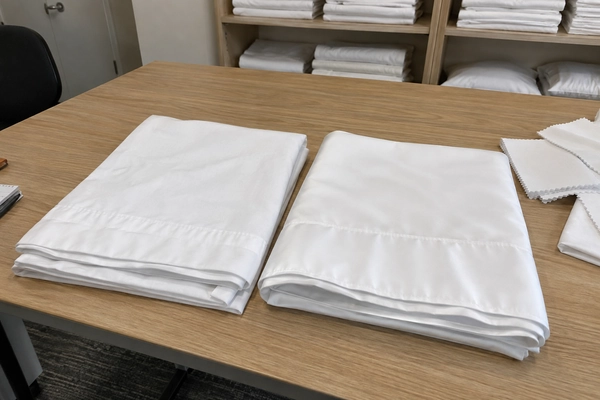
I have seen hotel operators reach very different decisions even when they serve similar guests. The right choice usually becomes clear only after we connect the fabric specification to the property’s room category, laundry process, replacement budget, and expected guest experience.
What Are CV Linens, and How Are They Different From Cotton?
Hotel buyers sometimes treat “CV” as if it described one fixed material. That assumption can lead to incorrect price and quality comparisons because mills and suppliers may use the term differently. I always begin by asking for the exact fiber content and finished-fabric specification.
CV linens generally refer to blended hospitality fabrics designed to balance cotton-like comfort with the stability and durability benefits of synthetic fibers, commonly polyester.[^1] Pure cotton uses cotton fiber throughout. Because CV terminology is not always standardized across suppliers and markets, buyers should verify the composition rather than rely on the product name.
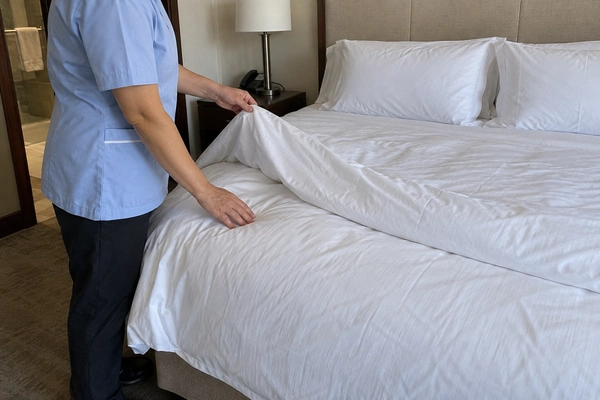
Composition Matters More Than the Product Label
I recommend treating “CV” as a commercial fabric category rather than a complete technical specification. One supplier may offer a cotton-rich blend, while another may use a higher percentage of polyester. The yarn size, thread construction, weave, finishing, and fabric weight can also differ.[^2]
A serious quotation should identify at least:
- Fiber composition by percentage
- Finished fabric weight in grams per square meter
- Yarn count or yarn specification
- Weave, such as plain, twill, sateen, or dobby
- Finished width
- Thread density or construction
- Whiteness and shade requirements
- Shrinkage limits
- Colorfastness requirements
- Care instructions and recommended wash conditions
These details determine how the bedding feels and performs. Two CV linens with the same nominal blend ratio can produce noticeably different guest experiences.
Cotton and CV Fabrics Have Different Strengths
I use the following comparison as an initial procurement framework. Buyers should still confirm each point through samples and controlled testing.
| Evaluation factor | CV linens | 100% cotton linens |
|---|---|---|
| Initial hand feel | Can range from crisp to soft, depending on finishing | Often naturally soft and familiar |
| Dimensional stability | Usually stronger when polyester is present | Usually more sensitive to heat and moisture |
| Shrinkage risk | Often lower under comparable conditions | Commonly higher without effective pre-shrinking |
| Moisture absorption | Usually lower than pure cotton | Generally higher |
| Drying requirements | May dry faster, depending on construction | Can require more drying time |
| Wrinkling | Often easier to control | Usually more prone to wrinkles[^3] |
| Premium perception | Depends on fabric quality and positioning | Strong natural-fiber association |
| Purchase price | Often commercially competitive | Varies widely by cotton grade and construction |
| Service-life cost | Can be attractive in high-turnover operations | Can be competitive when carefully laundered |
I have supplied bedding for mid- to high-end hospitality projects where the final CV fabric looked much more premium than buyers expected. I have also reviewed inexpensive blends that felt stiff or overly synthetic. Those experiences taught me that fiber labels do not replace finished-product evaluation.
I advise buyers to compare actual made-up sheets and duvet covers, not just small fabric swatches. Seams, hems, fabric tension, and finishing can change the overall result.
Do CV Linens Feel as Comfortable as Cotton?
Comfort is the main concern when a hotel considers moving away from pure cotton. A poor choice can affect guest perception, online reviews, and brand consistency. However, I have found that many buyers overestimate what the fiber label alone can tell them about actual sleeping comfort.
High-quality CV linens can offer a comfortable, cotton-like experience, but not every blend feels identical to pure cotton. Comfort depends on the blend ratio, yarn quality, weave, finishing, breathability, and laundering history. Hotels should test complete bedding sets in real rooms before approving a specification for large-scale purchasing.
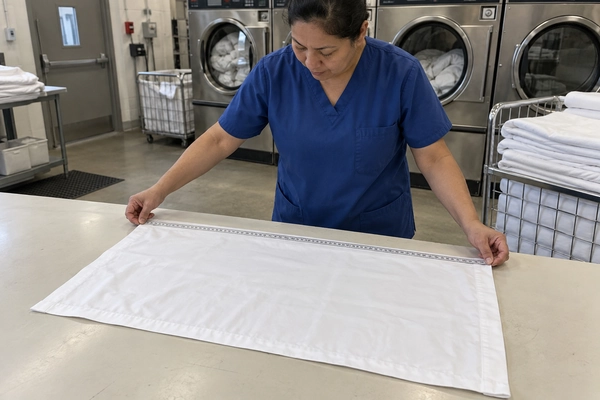
The Finished Fabric Creates the Guest Experience
Modern polyester-containing hospitality fabrics have improved considerably. Better yarn control, weaving, brushing, softening, and finishing can reduce the slick or rigid feel that buyers sometimes associate with older blended sheets.
I evaluate comfort through several separate characteristics:
- Initial touch: I check whether the surface feels smooth, dry, crisp, soft, or slippery.
- Drape: I observe how the sheet falls over the mattress and how the duvet cover moves.
- Breathability: I consider whether the construction allows heat and moisture to escape.
- Noise: I listen for excessive rustling when the fabric moves.
- After-wash feel: I compare the sample before washing and after several commercial cycles.
- Sleep perception: I ask room testers to evaluate warmth, surface friction, and overall comfort without seeing the fiber label.
A blind room trial can produce more useful feedback than a conference-room discussion. I have seen procurement teams change their initial preference after testing laundered samples instead of judging new swatches.
Cotton Still Has Clear Comfort Advantages
I do not present cotton as outdated. Good cotton can offer excellent absorbency, breathability, softness, and natural-fiber appeal.[^4] These qualities may be important for luxury suites, warm climates, wellness resorts, and properties that actively market natural materials.
However, “100% cotton” does not automatically mean premium quality. Shorter fibers, weak yarns, an unsuitable weave, or poor finishing can result in roughness, pilling, linting, and limited durability. In the same way, a CV label does not guarantee good dimensional stability or comfort.
Hotels should therefore compare:
- A washed CV sample and a washed cotton sample
- Identical or comparable fabric weights
- Similar weave constructions
- The same mattress, protector, duvet, and room climate
- Samples after multiple laundry cycles
- Feedback from housekeeping and laundry teams
- Feedback from guests or an internal sleep panel
For midscale and many upscale rooms, well-specified CV linens may meet the required comfort standard without creating an obvious downgrade. Luxury properties with a strong natural-material story may still prefer cotton. I view both choices as valid when they reflect the hotel’s positioning.
How Do CV Linens Perform Under Frequent Hotel Laundering?
Repeated laundering exposes weak specifications quickly. A sheet can look attractive when new but lose its dimensions, whiteness, surface quality, or seam stability after commercial processing. I therefore consider laundry performance one of the most important parts of a hospitality textile decision.
CV linens generally offer lower shrinkage, easier wrinkle control, and better dimensional stability than comparable cotton products because polyester absorbs less moisture and reacts differently to heat. However, actual results depend on the blend, fabric construction, finishing, wash chemistry, temperatures, mechanical action, drying process, and measurement method.
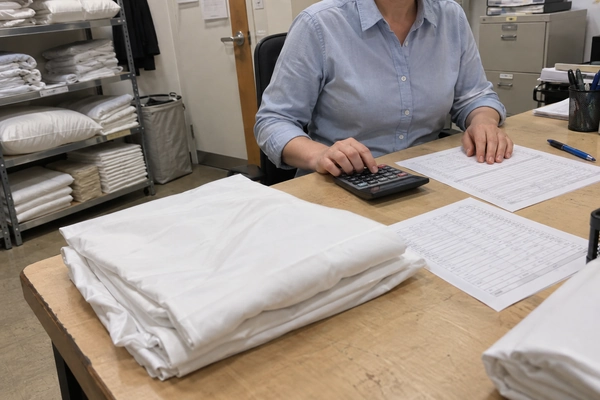
Shrinkage Affects More Than Appearance
Shrinkage can create several hidden operating costs. A fitted sheet that becomes too small takes longer to install and places more stress on corners and elastic. A duvet cover that loses length can distort the insert. Pillowcases may become difficult to close or fail to maintain the intended flap depth.
In my practical experience, polyester-containing CV linens can show substantially less shrinkage than cotton under comparable wash conditions. Some constructions may demonstrate shrinkage reductions approaching 50% relative to a cotton alternative.[^5] I would never present that figure as a universal guarantee, however.
A valid shrinkage comparison should define:
- The original fiber compositions
- Fabric construction and weight
- Whether either fabric was pre-shrunk
- Initial conditioning and measurement method
- Wash and rinse temperatures
- Detergent and chemical dosage
- Extraction speed
- Tumble-drying temperature and time
- Number of cycles
- Final conditioning before measurement
Without these conditions, a percentage claim has little procurement value.
Buyers Should Test the Complete Product
I recommend testing finished sheets, pillowcases, and duvet covers rather than fabric alone. Product dimensions, cutting direction, seam allowance, stitching, and sewing tension affect the result.
A practical pilot might include the following process:
- Measure and photograph 10 pieces from each proposed specification.
- Wash all pieces in the intended commercial process.
- Repeat measurements after 5, 10, 25, and 50 cycles.
- Record length and width shrinkage separately.
- Inspect seams, hems, labels, and closures.
- Monitor whiteness, pilling, snagging, and surface roughness.
- Ask housekeeping staff to record handling time and fit problems.
- Continue testing to the agreed service-life threshold.
Our own manufacturing experience includes linen constructions developed for demanding five-star applications, with certain products designed and tested for extended laundering performance. However, I ask buyers to verify any cycle-life statement against the exact product, defined wash protocol, and written test documentation. A claim such as “washable 280 times” should never be applied automatically to every fabric or operating environment.
Hotels should also involve their laundry company. Excessive dryer temperatures, overloading, aggressive alkali, incorrect bleaching, and poor chemical neutralization can damage both cotton and blended fabrics. A qualified laundry professional can help match the textile specification to the actual process.
Can CV Linens Reduce a Hotel’s Total Operating Cost?
Purchase price attracts attention because it appears clearly on a quotation. Yet a cheaper sheet can become expensive if it shrinks early, takes longer to process, or requires frequent replacement. I encourage buyers to compare total cost per usable room cycle instead of comparing unit prices alone.
CV linens may reduce total operating cost through lower shrinkage, faster processing, reduced ironing pressure, and a longer usable fit under frequent laundering. The financial benefit varies by property. Buyers should include purchase cost, wash expense, labor, energy, rejection rates, inventory losses, and replacement frequency in the calculation.
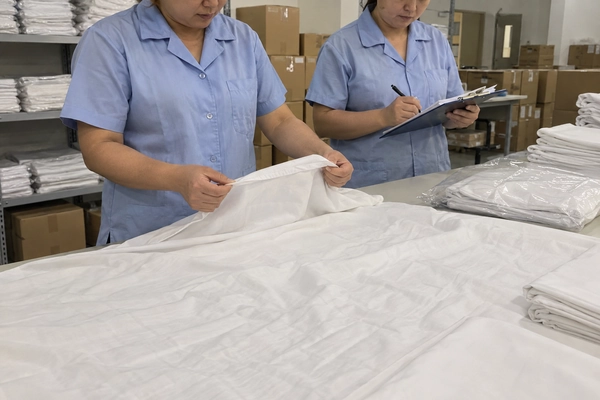
A Simple Total-Cost Model
I use a basic formula to start the discussion:
Cost per usable cycle = purchase price ÷ verified usable laundry cycles
This calculation is useful, but it is incomplete. A more realistic model includes the following costs:
| Cost category | Questions I ask |
|---|---|
| Product acquisition | What is the delivered cost, including freight and duties? |
| Laundry processing | How much water, chemistry, labor, and energy does each item require? |
| Drying and finishing | Does the item require longer drying or more ironing? |
| Shrinkage loss | How many pieces become unusable because they no longer fit? |
| Stain rejection | What percentage leaves service because stains cannot be removed? |
| Physical damage | How often do seams, hems, or fabric surfaces fail? |
| Inventory buffer | How much reserve stock is needed for processing and replacement? |
| Housekeeping labor | Does the product fit consistently and make beds efficiently? |
| Guest impact | Does the fabric support the expected room experience? |
For example, one product may cost 15% more but remain serviceable through significantly more verified cycles. Another product may have a low purchase price but create additional drying, ironing, or replacement costs. I avoid promising savings until a hotel supplies its own laundry and usage data.
High-Turnover Properties Often Value Stability
Linen-rental companies, serviced apartments, chain hotels, and busy resorts usually process textiles frequently. These operators tend to place greater value on predictable dimensions and efficient finishing. A small improvement per cycle can become meaningful across thousands of rooms.
Independent luxury hotels may use a different model. They may accept higher laundry and replacement costs to maintain a particular cotton specification or natural-fiber identity. I consider that a commercial choice rather than a technical error.
The best financial decision protects the guest experience first and then removes avoidable operating waste. If CV linens meet the approved comfort standard, their dimensional stability may create an attractive balance. If a particular blend fails the hotel’s touch, breathability, or brand-positioning requirements, its lower cost will not make it suitable.
How Should Buyers Evaluate CV Linens and Suppliers?
A product specification can look convincing while leaving essential details undefined. That uncertainty creates risk during repeat orders, especially when suppliers change yarns, mills, or finishing processes. I recommend evaluating both the fabric and the supplier’s ability to maintain the approved standard over time.
Buyers should evaluate CV linens through documented specifications, representative samples, controlled wash trials, quality inspections, and supplier audits. They should also confirm production capacity, raw-material traceability, shade control, dimensional tolerances, testing methods, and change-management procedures before placing a large or multi-property order.
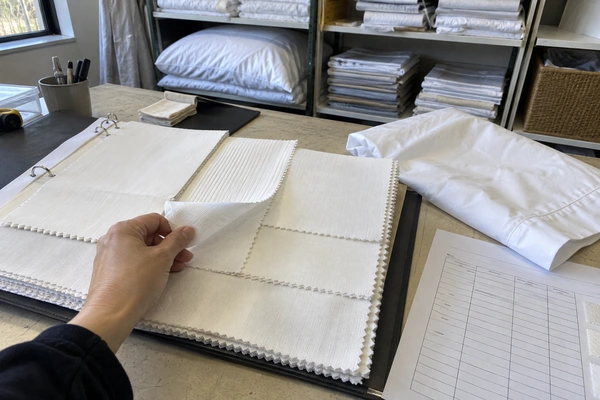
Build a Written Approval Standard
I advise procurement teams to create a reference specification that becomes part of the purchase agreement. The document should include measurable requirements rather than subjective phrases such as “hotel quality” or “luxury feel.”
The approval standard can include:
- Exact fiber composition and permitted tolerance
- Yarn and weave construction
- Finished fabric weight and width
- Product dimensions and dimensional tolerances
- Color or whiteness target
- Shrinkage limits in warp and weft directions
- Pilling and abrasion requirements
- Tensile or tear-strength requirements where relevant
- Seam construction and stitches per unit length
- Label, packaging, and carton requirements
- Approved wash-test method
- Golden sample or sealed reference sample
- Pre-shipment inspection procedure
I also suggest retaining samples from each production batch. These samples help buyers investigate differences if a later delivery feels, fits, or washes differently.
Verify Supplier and Certification Claims
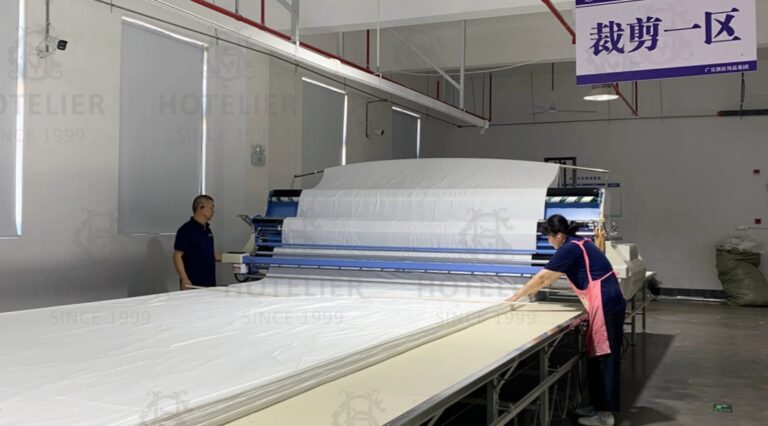
Our company, Hotelier, has manufactured hotel linen and hospitality supplies in Jiangsu since 1999. We operate a facility of more than 40,000 square meters with around 300 employees, and we have supplied international and domestic hospitality projects. That background gives me firsthand exposure to the way hotel buyers weigh comfort, consistency, laundering, and cost.
I have also observed growing interest in CV materials among mid- to high-end hotel operators. Based on our supply experience, relevant requirements associated with some Marriott and Hilton projects began shifting toward CV options around 2020. However, buyers should verify the exact brand, region, product category, standard version, and effective date before treating that observation as a current brand requirement. International groups do not necessarily apply one identical specification to every property.
The same caution applies to certifications. Buyers should review:
- The certificate holder’s legal name
- Covered factory address
- Product scope
- Standard version
- Issue and expiry dates
- Testing laboratory
- Report number and test method
- Whether the certificate covers the actual ordered product
I recommend third-party laboratory testing and qualified textile or laundry evaluation when performance is critical. A supplier’s experience can guide the process, but it should not replace application-specific evidence.
Frequently Asked Questions
Are CV linens the same as polycotton?
CV linens are often polyester-containing blends, but the term does not always identify one universal composition. Some suppliers may use related terminology differently. I recommend requesting the exact cotton and polyester percentages, yarn construction, fabric weight, weave, and test results before comparing a CV product with polycotton or pure cotton.
Do CV linens feel synthetic?
Some low-quality blends can feel slick, stiff, or synthetic. A well-developed CV fabric can feel soft, smooth, and comfortable because yarn choice, weave, and finishing strongly influence touch. I recommend evaluating washed, full-size bedding in a guest room rather than relying on an unwashed swatch.
How much less do CV linens shrink than cotton?
CV products often shrink less than cotton under equivalent conditions, and some constructions may show reductions approaching 50%. However, no single percentage applies to every product. Buyers should compare samples using the same wash chemistry, temperature, drying process, cycle count, conditioning, and measurement method.
Are cotton linens always better for luxury hotels?
Cotton can support a luxury property’s natural-material positioning and provide excellent softness and moisture absorption. However, cotton quality varies, and modern CV linens may satisfy the comfort standards of many upscale properties. I recommend selecting the fabric according to guest expectations, room category, laundry conditions, and brand requirements.
How many times can hotel linens be washed?
The number varies with fiber content, construction, wash chemistry, stain treatment, drying temperature, handling, and rejection criteria. Buyers should not accept a wash-cycle claim without a defined protocol. I recommend running a controlled trial and agreeing on what counts as failure before comparing expected service life.
Conclusion
CV linens can offer hotels a practical balance of guest comfort, lower shrinkage, dimensional stability, and controlled replacement costs. Cotton remains a strong option when natural feel, absorbency, and premium positioning take priority. I recommend comparing complete, washed products under the property’s real laundry conditions instead of choosing by fiber label or purchase price alone. If you need help evaluating CV and cotton specifications, Hotelier can provide samples, procurement guidance, and one-stop hotel linen support for a documented wash and quality trial.
[^1]: "Textile", https://en.wikipedia.org/wiki/Textile. Textile references should be consulted for the applicable meaning of “CV,” because the abbreviation can denote different materials or processes and does not by itself establish a cotton–polyester composition. Evidence role: definition; source type: education. Supports: The source should define the relevant textile use of “CV” and clarify whether it denotes a particular fiber or blend.. Scope note: A general textile glossary may clarify the abbreviation without proving that hospitality suppliers use it consistently across all markets. [^2]: "The Effect Of Weave Construction On Tear Strength ...", https://www.academia.edu/55226898/The_Effect_Of_Weave_Construction_On_Tear_Strength_Of_Woven_Fabrics. Textile studies identify yarn characteristics, fabric construction, mass per unit area, and finishing as determinants of properties including handle, drape, strength, air permeability, and wear performance. Evidence role: mechanism; source type: paper. Supports: The source should explain how yarn, weave, mass per unit area, and finishing influence textile handle and performance.. Scope note: The magnitude and direction of each effect depend on the particular fiber system and finishing process. [^3]: "TRL - Synthetic Fibers - Textile Research Lab", https://textileresearchlab.pratt.edu/fibers/synthetic-fibers. Studies of crease recovery show that polyester and polyester–cotton blends generally recover from deformation more effectively than untreated cotton fabrics, providing a material basis for reduced wrinkling. Evidence role: mechanism; source type: paper. Supports: The source should show that polyester or polyester blending generally improves crease recovery relative to untreated cotton.. Scope note: Wrinkle appearance remains sensitive to weave, resin or mechanical finishing, laundering, drying, and ironing. [^4]: "Factors Affecting Perceived Comfort of Selected Flame Retardant ...", https://repository.lib.ncsu.edu/items/eda2dfb4-8bd2-4b24-957f-87437eb47ea6. Cotton's hydrophilic cellulose structure supports relatively high moisture absorption, and suitable cotton constructions can provide soft, air-permeable bedding surfaces. Evidence role: general_support; source type: research. Supports: The source should support cotton's moisture affinity and its common use in comfort-oriented textiles, while distinguishing physical properties from consumer perceptions.. Scope note: Breathability and softness are finished-fabric properties rather than guaranteed consequences of cotton content, while natural-fiber appeal requires separate consumer evidence. [^5]: "Particle Shedding from Cotton and Cotton-Polyester Fabrics in ...", https://pmc.ncbi.nlm.nih.gov/articles/PMC10421144/. A controlled comparison may substantiate a reduction of this magnitude only when the cotton and blended products are tested using the same conditioning, laundering, drying, cycle-count, and measurement procedures. Evidence role: statistic; source type: paper. Supports: The source should report measured percentage shrinkage for matched cotton and polyester-containing fabrics under the same laundering protocol.. Scope note: A result from one construction or wash protocol cannot establish a general 50% reduction for all CV linens.