
Which Towel Is Used in a 5 Star Hotel?
A 5 star hotel towel must feel luxurious without becoming unnecessarily heavy, slow to dry, or expensive to launder. Many buyers assume that a higher GSM always means better quality. That assumption can raise operating costs without improving guest satisfaction. I recommend balancing cotton quality, construction, finished weight, absorbency, and wash durability.
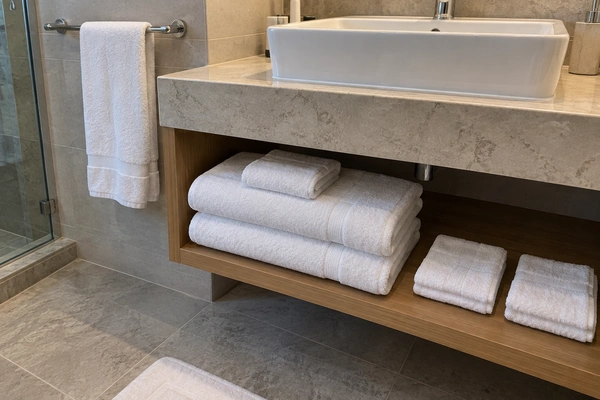
A 5 star hotel commonly uses a 100% cotton terry towel around 600–700 GSM. A practical premium benchmark is approximately 650 GSM, although the ideal specification depends on towel size and purpose.[^1] Buyers should also evaluate yarn quality, absorbency, softness, shrinkage, drying time, and durability after commercial laundering.
I have learned that GSM alone never tells the whole story. A lighter, well-constructed towel can outperform a heavier towel made with poor yarn or loose weaving. To select the right hotel towel, I review each product by application, dimensions, finished weight, construction, and expected laundry conditions.
What Type of Towel Is Used in a 5 Star Hotel?
Hotel buyers face a difficult balance. Guests expect softness, thickness, and excellent absorbency, while operators need fast drying and predictable laundry costs. If I select only by hand feel, I may overlook shrinkage, linting, seam strength, or poor performance after repeated washes.
A typical 5 star hotel towel is a white, highly absorbent cotton terry towel with a dense but controlled pile. Combed cotton or another verified premium cotton construction is common. The towel should have reinforced hems, consistent dimensions, low linting, and a weight appropriate for its function rather than the highest possible GSM.
Why do luxury hotels usually choose white towels?
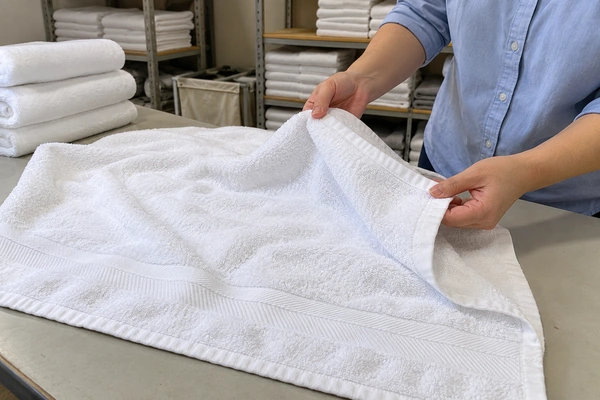
I usually recommend white because it supports consistent hotel operations. Housekeeping teams can identify stains quickly, and commercial laundries can process matching towel inventories without separating many colors. White also communicates cleanliness to guests and fits almost any bathroom design.
However, white does not automatically mean high quality. I still inspect:
- Cotton fiber and yarn consistency
- Terry-loop density and height
- Finished towel weight
- Absorbency speed
- Color consistency between production lots
- Shrinkage after washing and tumble drying
- Lint release during early wash cycles
- Hem and border strength
- Resistance to hard-water graying
Hotels can also use dyed towels in spas, pools, gyms, or branded suites. In those cases, I ask for colorfastness test results and assess possible fading from chlorine, peroxide, detergents, cosmetics, and repeated high-temperature processing.
What cotton construction should buyers consider?
I commonly encounter ring-spun cotton, combed cotton, zero-twist yarn, low-twist yarn, and conventional twisted terry yarns. Each option has advantages and trade-offs.
| Construction | Typical benefit | Main procurement concern |
|---|---|---|
| Combed cotton | Smooth feel and more uniform fibers | Buyers should verify the actual yarn specification |
| Ring-spun cotton | Good balance of softness and strength | Performance varies with yarn count and weaving |
| Zero-twist cotton | Plush feel and high initial absorbency | It may lint more or wear faster in harsh laundries[^2] |
| Low-twist cotton | Softness with some yarn stability | Buyers should test wash durability |
| Conventional twisted yarn | Strong and practical for repeated washing | It may feel less plush than low-twist options |
I do not treat any one construction as automatically superior. A resort with an on-premise laundry may select a different towel from a city hotel using an industrial laundry service. Chemical dosage, extraction pressure, dryer temperature, water hardness, and handling methods can change towel performance.
At our factory in Jiangsu, we have manufactured hotel linen and amenities since 1999. We use this production experience when discussing specifications, but I still encourage every buyer to approve samples under the buyer’s own laundry conditions. A qualified textile laboratory or laundry professional should evaluate application-specific requirements.
What GSM Should a 5 Star Hotel Towel Have?
GSM often causes confusion during procurement. Buyers may treat a high number as a simple quality grade, so suppliers may respond by offering a heavier product. This approach can create longer drying cycles, larger laundry loads, and slower room turnover without guaranteeing better durability.
I generally view about 650 GSM as a strong reference point for a 5 star hotel towel. A practical premium range is often 600–700 GSM. Some bath towels may be heavier, but buyers should compare finished weight, dimensions, pile construction, drying performance, and wash-test results before approving a specification.
What does GSM actually measure?
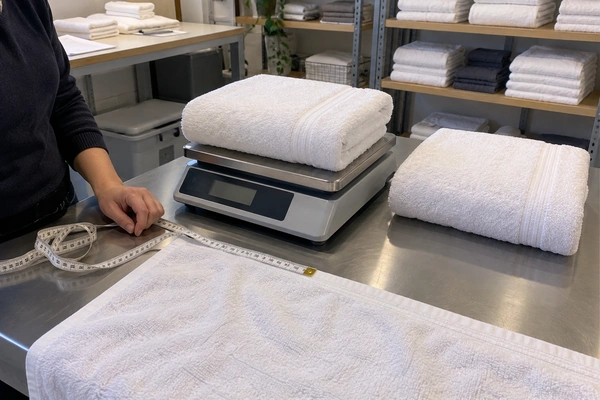
GSM means grams per square metre. It measures fabric mass relative to surface area. It does not directly measure the finished weight of an individual towel.
I calculate estimated finished weight with this formula:
Estimated towel weight = width in metres × length in metres × GSM
For example, an 80 × 150 cm bath towel has an area of 1.2 square metres. At 650 GSM, its theoretical weight is:
0.8 × 1.5 × 650 = 780 grams
Borders, hems, weaving differences, finishing, moisture regain, and manufacturing tolerances can affect the actual finished weight. Therefore, a specification may state both a target GSM and a target piece weight with an agreed tolerance.
A finished bath towel weighing approximately 850 grams at 80 × 150 cm works out to about 708 GSM before considering testing methods and production tolerances. I would describe that towel as a substantial luxury specification rather than calling it a universal 650 GSM product.
Why is the heaviest towel not always the best?
A very heavy towel can feel impressive during a showroom inspection, but hotel operations continue long after the sample meeting. I examine the complete operating impact.
An excessively heavy towel may:
- Absorb more water during washing, which increases extraction and drying demands.
- Take longer to dry, especially if the pile is dense and airflow is limited.[^3]
- Reduce machine capacity, because fewer pieces fit in each wash load.
- Increase transportation cost, particularly for outsourced laundries.
- Slow housekeeping handling, since wet towels are considerably heavier.
- Develop odors if stored damp, especially in humid areas.
- Raise replacement cost, even when the extra material does not extend service life.
A towel below approximately 500 GSM may suit an economy property, gym, or high-turnover operation, but it may not deliver the plush hand expected in a luxury bathroom. A towel above 750 GSM can offer a highly indulgent feel, yet I would test whether the property’s laundry system can process it efficiently.
I treat 600–700 GSM as an evaluation range rather than an absolute rule. The best specification is the one that maintains softness, absorbency, appearance, and dimensional stability through the hotel’s expected service cycle.
Which 5 Star Hotel Towel Sizes and Weights Should Buyers Specify?
Hotels need more than one towel, and each item serves a different purpose. If I apply the same GSM or purchasing logic to every size, I can create an unbalanced collection. A face towel, bath towel, beach towel, and bath mat require different structures and finished weights.
A coordinated 5 star hotel towel collection may include an 80-gram washcloth, a 220-gram hand or face towel, a 320–330-gram European-size towel, and an 850-gram bath towel measuring 80 × 150 cm. A 100 × 150 cm beach towel at approximately 620 GSM is another practical premium benchmark.
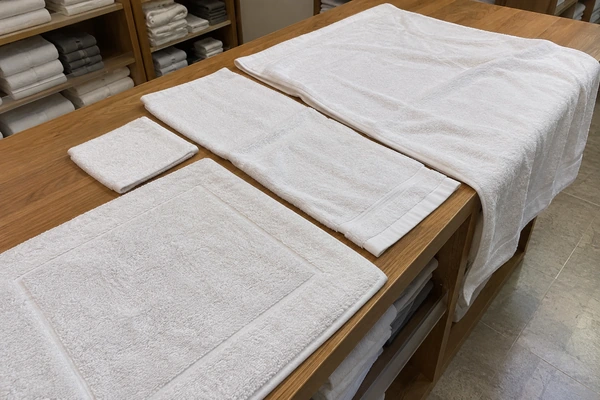
A practical luxury hotel towel specification
The following table reflects useful procurement benchmarks from our manufacturing context. It does not represent a universal standard for every five-star hotel or every brand.
| Towel item | Example size | Example finished weight or GSM | Procurement notes |
|---|---|---|---|
| Washcloth or square towel | About 30 × 30 cm | About 80 g per piece | Buyers should check softness, edge strength, and makeup-stain handling |
| Hand or face towel | Size varies by program | About 220 g per piece | Buyers should specify dimensions because the product name varies by market |
| European-style towel | 50 × 90 cm | About 320–330 g per piece | The calculated GSM is roughly 711–733 |
| Bath towel | 80 × 150 cm | About 850 g per piece | This substantial specification is suitable for premium positioning |
| Beach or pool towel | 100 × 150 cm | About 620 GSM | The estimated piece weight is about 930 g |
| Long-pile bath mat | 60 × 90 cm | About 1,000 g per piece | This item often has the highest unit cost in the towel set |
I always clarify whether a quoted number means GSM or finished piece weight. The difference is critical. An 80-gram washcloth does not mean 80 GSM. If it measures 30 × 30 cm, its approximate calculated GSM is 889. That high figure can make sense because a small cloth needs enough substance to feel comfortable and survive repeated handling.
Likewise, a 220-gram face or hand towel needs dimensions before I can interpret its fabric density. Regional naming also causes confusion. Some buyers call a 50 × 90 cm item a hand towel, while others call it a face towel or guest towel. A purchase order should never rely only on the product name.
What is special about a luxury bath mat?
A long-pile bath mat measuring 60 × 90 cm and weighing around one kilogram is a substantial product. It often costs more than the other terry items because it uses more cotton, requires a strong base, and needs durable edge construction.
I inspect bath mats for:
- Surface stability under wet feet
- Pile recovery after washing
- Skid risk in the intended bathroom environment
- Hem distortion and edge curling
- Drying time
- Dimensional shrinkage
- Compatibility with heated floors
- Resistance to frequent washing
A textile bath mat is not automatically a certified anti-slip product. Hotel operators should obtain an appropriate safety assessment for the actual floor, laundering process, and guest environment.
In our supplied business context, we began implementing a more fixed Ritz-Carlton towel specification in 2025. The referenced set included an 80 × 150 cm bath towel at approximately 850 grams and a 60 × 90 cm long-pile bath mat at approximately one kilogram. I treat these figures as a project benchmark from our manufacturing experience, not as a global specification for every Ritz-Carlton property. Buyers should verify current requirements with the relevant hotel group and approved procurement documents.
How Should I Evaluate a 5 Star Hotel Towel Supplier?
A towel can look excellent before washing and disappoint after several laundry cycles. If I approve a supplier only from an unwashed sample, I may miss excessive linting, shrinkage, border distortion, poor absorbency, or lot-to-lot variation.[^4] A structured supplier evaluation reduces these risks.
I evaluate a 5 star hotel towel supplier through documented specifications, pre-production samples, controlled wash trials, factory quality systems, testing records, production capacity, and commercial support. I also confirm measurement tolerances, inspection methods, packaging, traceability, delivery schedules, replacement procedures, and consistency across repeat orders.
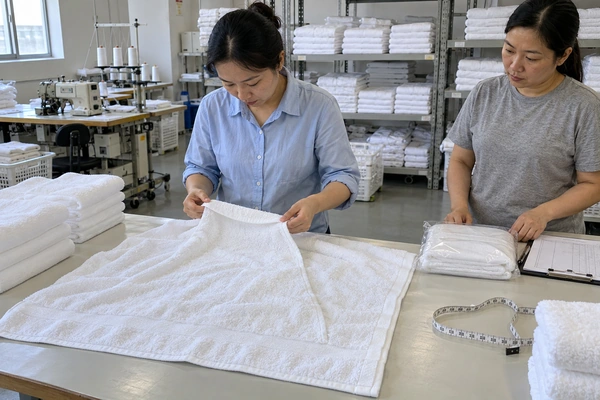
Start with a complete specification sheet
A professional request for quotation should contain enough detail for suppliers to quote the same product. I include:
- Finished width and length
- Target GSM and finished piece weight
- Permitted weight and dimensional tolerances
- Cotton composition and yarn construction
- Terry structure, pile height, and loop style
- Border width and design
- Hem type and stitch density
- Color or whiteness requirement
- Logo method, if applicable
- Expected shrinkage limits
- Absorbency requirement
- Linting or weight-loss limits
- Wash-test procedure
- Packing and labeling requirements
- Order quantity and replenishment plan
I avoid comparing quotations when one supplier quotes a combed-cotton, high-density product and another quotes a visually similar towel with different yarn or loose pile. Those prices do not represent equivalent products.
Run a realistic laundry trial
I recommend testing multiple pieces rather than one showroom sample. The trial should reproduce the hotel’s actual washing process as closely as possible.
A useful evaluation can include checks at these stages:
| Test stage | What I assess |
|---|---|
| Before washing | Dimensions, weight, shade, hand feel, seams, and visual defects |
| After 1–3 washes | Initial shrinkage, linting, absorbency, and surface change |
| After 20–30 washes | Hem stability, pile wear, softness, and discoloration |
| Extended trial | Service-life trend, guest presentation, and cost per use |
Our business context includes a claim that our self-developed and self-woven linen fabric has been adopted within a Marriott supply program and that selected five-star linen products can withstand up to 280 washes under the relevant test or use conditions. I would not transfer that claim automatically to every towel construction. Buyers should ask for the exact product, wash protocol, pass criteria, and supporting report before using any cycle claim in a procurement decision.
Verify the supplier behind the sample
I also assess whether the supplier can repeat the approved quality in bulk. Our Hotelier factory was founded in Jiangsu in 1999. We employ about 300 people, operate on a site exceeding 40,000 square metres, and have supplied hotel product programs associated with major international and domestic properties. We also support one-stop procurement across hotel linen and consumables.
I share these facts because factory scale and experience can reduce sourcing complexity. However, buyers should verify every supplier independently. I recommend reviewing:
- Business licenses and manufacturing scope
- Factory audit reports
- Quality-control procedures
- Raw-material traceability
- In-house and third-party testing capabilities
- Relevant certificates and their validity
- Approved sample retention
- Capacity and lead-time evidence
- References for comparable hotel projects
- Corrective-action procedures
Certifications are documents to verify, not substitutes for product testing. A qualified textile specialist, testing laboratory, commercial laundry consultant, or hotel procurement professional should confirm the final specification for the intended application.
Frequently Asked Questions
Are 5 star hotel towels always 100% cotton?
Many luxury hotels use 100% cotton because it offers good absorbency, softness, and guest familiarity. However, I still verify the fiber declaration and test performance. Some specialized pool, spa, or quick-dry programs may use blended materials. The correct choice depends on brand positioning and laundry conditions.
Is 700 GSM too heavy for a hotel bath towel?
A 700 GSM bath towel can be suitable for a luxury hotel, but I would test its drying time, wet handling, shrinkage, and cost per wash. The dimensions also matter. A large 700 GSM towel may place more demand on laundry equipment than a smaller towel with the same GSM.
How often should a luxury hotel replace its towels?
I do not recommend replacing towels according to one fixed number of washes. Laundry chemistry, guest use, staining, dryer temperature, and towel construction affect service life. Hotels should remove towels when they fail standards for whiteness, absorbency, dimensions, softness, seam integrity, or presentation.
What is the difference between GSM and towel weight?
GSM measures grams per square metre, while towel weight measures the mass of one finished piece. I calculate approximate piece weight by multiplying width, length, and GSM. Buyers should specify both values because two towels can have the same GSM but different finished weights due to different dimensions.
Should hotel buyers request samples before placing a bulk order?
Yes. I recommend approving pre-production samples and washing several pieces under realistic commercial conditions. Buyers should record dimensions, weight, absorbency, linting, shrinkage, and visual changes. A signed approval sample should then serve as the reference for bulk inspection and repeat production.
Conclusion
The best 5 star hotel towel is not simply the heaviest option. I usually start around 650 GSM, then assess cotton quality, finished dimensions, piece weight, absorbency, drying time, shrinkage, linting, and wash durability. An 80 × 150 cm bath towel at about 850 grams can provide a substantial luxury feel, while other towel sizes need their own balanced specifications.
If you are sourcing towels for a boutique hotel, hotel group, distributor, laundry rental company, or short-term rental portfolio, contact Hotelier to discuss samples, custom specifications, wash testing, and one-stop hotel linen procurement.
[^1]: "(PDF) Network relationships and the internationalisation of ...", https://www.academia.edu/1222722/Network_relationships_and_the_internationalisation_of_the_tourism_economy_The_case_of_Portuguese_overseas_investment_in_the_hotel_sector. Hospitality and textile references commonly place heavier premium bath towels in a range near 600–700 g/m², although GSM classifications are procurement conventions rather than a universal five-star standard. Evidence role: general_support; source type: research. Supports: Independent hospitality or textile evidence should document typical GSM ranges used for premium hotel bath towels and explain variation by towel type or dimensions.. Scope note: Published GSM ranges may describe market practice rather than a formal hotel-rating requirement. [^2]: "Highly Soft, Abrasion-Resistant, and Moisture-Absorbent Wool ...", https://pmc.ncbi.nlm.nih.gov/articles/PMC11281004/. Textile studies show that yarn twist influences fiber cohesion, tensile behavior, and hairiness; consequently, very low-twist constructions may trade plushness for reduced resistance to linting or abrasion. Evidence role: mechanism; source type: paper. Supports: Textile research should establish how lower yarn twist can reduce fiber cohesion and affect yarn strength, hairiness, abrasion, or lint release.. Scope note: General yarn-mechanics evidence does not establish that every zero-twist towel will wear faster, because fiber quality, pile construction, and finishing also affect durability. [^3]: "Drying Performance of Fabrics on the Human Body - PMC", https://pmc.ncbi.nlm.nih.gov/articles/PMC12155929/. Textile-drying studies show that drying time is governed by retained moisture and heat and mass transfer; greater fabric mass or thickness and restricted airflow can therefore prolong drying. Evidence role: mechanism; source type: paper. Supports: Drying research should show that greater retained water and resistance to heat and mass transfer can extend textile drying time.. Scope note: GSM by itself does not determine drying time, which also depends on extraction efficiency, load size, machine design, temperature, and fabric structure. [^4]: "The effect of fabric structure parameters on dimensional ...", https://www.academia.edu/111358273/The_effect_of_fabric_structure_parameters_on_dimensional_stability_after_domestic_washing. Standard textile test methods assess dimensional change, appearance, and related performance after controlled washing and drying, confirming that these characteristics cannot be determined reliably from an unlaundered sample alone. Evidence role: general_support; source type: institution. Supports: Recognized textile standards should demonstrate that dimensional stability and appearance retention are evaluated after specified washing and drying cycles.. Scope note: Standard laboratory cycles may not reproduce every commercial laundry's chemistry, mechanical action, or operating temperature.