Who Makes the Best Quality Bed Linen?
The best quality bed linen can be difficult to identify because a luxury label, high thread count, or premium price does not always guarantee better performance[^1]. Poor construction can lead to shrinkage, pilling, and early failure. I recommend comparing yarn quality, weave, finishing, consistency, and wash durability before selecting a manufacturer.
The best quality bed linen is made by manufacturers that combine fine yarns, appropriate fabric construction, controlled finishing, precise sewing, and consistent quality inspection. Italian luxury brands are known for refined craftsmanship, while experienced Chinese manufacturers can offer a strong balance of quality, durability, customization, and procurement cost for hotels and commercial buyers.
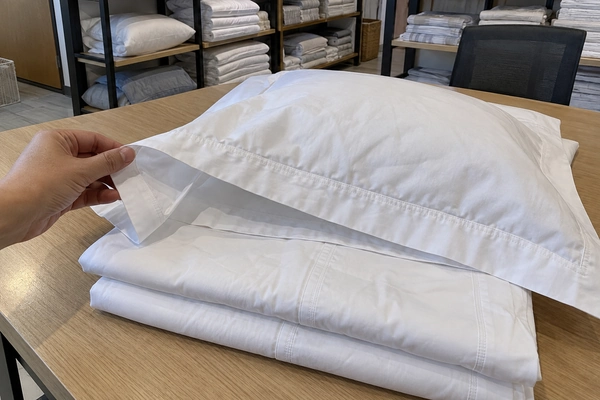
I do not believe that one manufacturer is automatically best for every buyer. A luxury residence, five-star resort, linen rental company, and boutique hotel have different requirements. The useful question is which supplier can deliver the right comfort, appearance, durability, and cost for a specific operation.
Which Country Makes the Best Quality Bed Linen?
Country-of-origin claims often make bed linen sourcing more confusing. Buyers may assume that European production always means superior quality or that Asian production always means lower cost. Neither assumption is reliable. I look beyond the country label and examine the materials, construction, production controls, and intended use.
Italy is widely associated with refined luxury bed linen, especially intricate finishing and premium fabric construction. China has a broader manufacturing base and can produce anything from economy linen to highly engineered five-star hotel products. In my experience, the best result depends more on the factory’s technical capability and consistency than on its country alone.
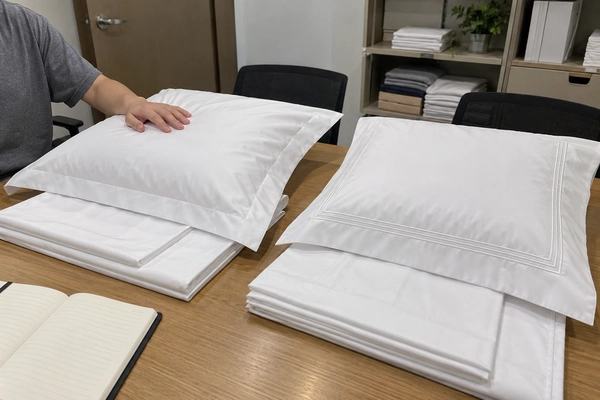
Why Is Italian Bed Linen Highly Regarded?
Italian textile mills and luxury brands have built strong reputations around fabric refinement. Frette is one of the best-known examples. Its products occupy the high end of the luxury retail and hospitality market, and individual pillowcases can retail for several hundred US dollars, depending on the collection and market.
The brand is also associated with prestigious hotels, residences, and royal or institutional clients. However, I recommend verifying current supply relationships, royal warrants, and product specifications directly. Luxury brand histories can change, and not every collection uses the same construction.
The main advantage is not simply an “Italian” label. It usually comes from a combination of:
- Fine and carefully selected yarns
- Sophisticated woven constructions
- Controlled dyeing and finishing
- Precise cutting and sewing
- Refined embroidery or decorative details
- Strong luxury branding and distribution
- Strict visual standards
I once compared two fabrics that both carried a 300 thread count specification. One felt more substantial, smoother, and more stable after washing. That comparison reinforced an important sourcing lesson for me: identical headline numbers can conceal very different constructions.
Where Does Chinese Manufacturing Excel?
China has a highly developed textile supply chain.[^2] Manufacturers can source yarn, weave greige fabric, bleach or dye it, apply finishing treatments, cut components, sew products, and arrange packaging within an integrated manufacturing ecosystem.
That supply-chain depth supports several commercial advantages:
- Flexible specifications: Buyers can select yarn count, weave, dimensions, color, and sewing details.
- Scalable production: Experienced factories can support hotel openings and chain-wide replacement programs.
- Cost control: Suppliers can match construction to a target cost without relying only on brand positioning.
- Product development: Strong manufacturers can recreate, modify, or improve technically demanding structures.
- One-stop procurement: Hotels can source sheets, duvet covers, towels, bathrobes, protectors, and amenities together.
The challenge is that capability varies widely. Some factories can make an impressive sample but struggle to reproduce it consistently across thousands of pieces. I therefore treat repeatability as part of quality, not as a separate issue.
| Sourcing factor | Italian luxury supplier | Experienced Chinese hotel supplier |
|---|---|---|
| Luxury brand value | Usually very high | Depends on supplier and buyer market |
| Fabric refinement | Often excellent | Can range from basic to excellent |
| Customization | Available, sometimes costly | Usually broad and flexible |
| Commercial volume | Collection-dependent | Often highly scalable |
| Lead-time flexibility | Varies | Often competitive |
| Cost-performance balance | Focused on luxury positioning | Often a major strength |
| One-stop hotel supply | May be limited | Frequently available |
I would not choose a supplier based on this table alone. I would request samples, test reports, references, and written production specifications before approving an order.
How Does Yarn Construction Affect the Best Quality Bed Linen?
Thread count is easy to market, so buyers often focus on it first. That approach can create problems. A high number may come from multi-ply yarns, counting methods, or dense construction that reduces breathability. I prefer to investigate the yarn itself before I compare the final thread count.
Yarn construction affects softness, strength, weight, surface smoothness, and wash life. Fine single yarns can create a light and refined fabric, while properly engineered two-ply yarns can improve stability and durability. The best quality bed linen uses a yarn structure that supports its intended weave and laundering conditions.
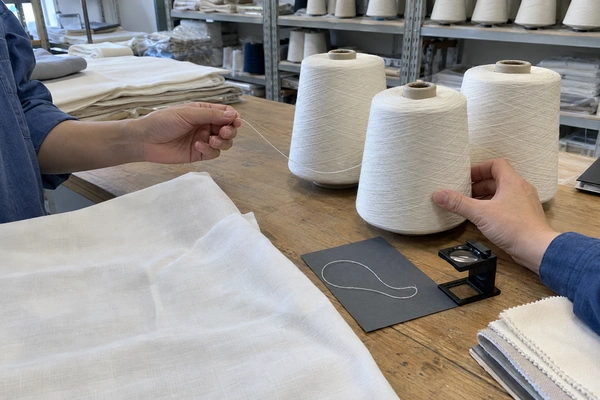
What Do 60s, 80s, and 120s Yarn Counts Mean?
In the English cotton count system, a higher yarn count generally indicates a finer yarn. For example, 80s yarn is finer than 40s yarn. Fine yarn can produce a smoother and lighter fabric, but fineness alone does not guarantee strength.
A simplified comparison looks like this:
| Yarn description | General character | Typical sourcing consideration |
|---|---|---|
| 40s single yarn | Relatively substantial | Practical for durable commercial products |
| 60s single yarn | Finer and smoother | Common in upper-tier hotel linen |
| 80s single yarn | Fine and refined | Requires strong spinning and weaving control |
| 120s single yarn | Very fine | Demands high-quality fiber and careful processing |
| 2/80s two-ply yarn | Two 80s yarns twisted together | Can add body, stability, and strength |
| 2/120s two-ply yarn | Two 120s yarns twisted together | Can combine refinement with engineered stability |
These descriptions are general. Fiber length, twist level, yarn evenness, hairiness, weaving tension, and finishing can substantially change the result.
Why Can Two 300 TC Fabrics Feel Different?
A conventional 300 TC hotel sateen may use a construction such as 60s warp yarn and 40s weft yarn. Sateen places more yarn on the surface, which often creates a smooth hand and subtle sheen. It is popular because guests tend to recognize its soft, luxurious feel.
A more complex 300 TC construction can use fine yarns twisted into two-ply yarn before weaving. For example, two 80s yarns may be combined into a nominal 2/80s construction, which has a resultant count broadly comparable to a 40s yarn under the English count convention[^3]. The finished fabric may then use a plain weave rather than sateen.
This structure can offer:
- Greater yarn integrity
- A crisp and controlled hand
- Good dimensional stability
- Dense construction without relying only on surface floats
- Better resistance to snagging in some applications
- A balance between refinement and commercial durability
Our team began developing a related construction in 2022. We later worked with two 120s yarns twisted into a 2/120s yarn, giving us a fine two-ply structure with a nominal resultant count near 60s. I view this as an example of adapting a luxury textile concept rather than simply copying a brand specification.
The important issue was production stability. A laboratory sample can look excellent, but commercial hotel supply requires consistent yarn twisting, loom settings, finishing, shade, shrinkage, and sewing. We produced this type of linen for the 194-room Vilamendhoo Island Resort & Spa in the Maldives. Buyers should still evaluate current samples and application-specific test results rather than relying on one project reference.
Is Thread Count the Best Way to Judge Quality Bed Linen?
Thread count creates a convenient number for product listings, but it can hide more than it reveals. Buyers may pay for a 600 TC or 1,000 TC label and still receive a heavy, poorly ventilated fabric. I use thread count as one data point rather than as a complete quality grade.
Thread count is not the best standalone measure of bed linen quality. Buyers should assess fiber quality, yarn count, single- or multi-ply construction, weave, fabric weight, finishing, shrinkage, seam strength, and laundering performance. A well-made 300 TC fabric can outperform a poorly constructed product with a much higher advertised count.
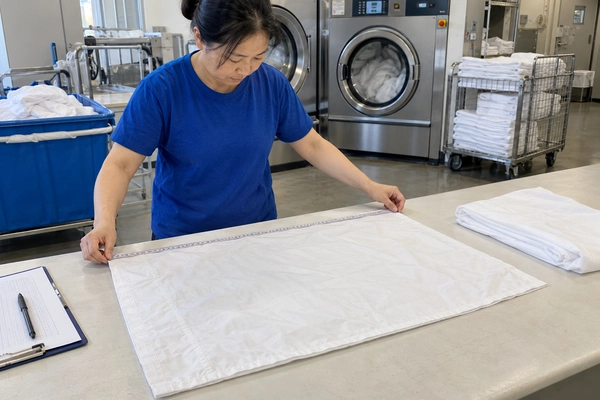
Which Specifications Should Buyers Request?
I recommend asking suppliers for a full specification sheet instead of a marketing description. The sheet should identify the construction clearly enough for a buyer or independent laboratory to check it.
Useful information includes:
- Fiber composition and claimed cotton type
- Warp and weft yarn counts
- Single-ply or multi-ply construction
- Ends per inch and picks per inch
- Total thread count and counting method
- Weave type
- Fabric weight in grams per square meter
- Bleaching, dyeing, and finishing method
- Expected shrinkage after washing
- Colorfastness where applicable
- Seam construction and stitches per inch
- Finished dimensions and tolerances
A supplier should also explain whether the dimensions are measured before or after laundering. Hotel operators need sufficient allowances for shrinkage, mattress depth, bed-making methods, and industrial finishing.
How Do Percale and Sateen Compare?
Percale and sateen can both produce premium linen. They simply prioritize different characteristics.
| Feature | Percale or plain weave | Sateen weave |
|---|---|---|
| Typical feel | Crisp and fresh | Smooth and silky |
| Surface | Matte | Subtle sheen |
| Breathability | Often very good | Depends on density and finishing |
| Snag resistance | Often strong due to shorter floats | Longer floats may need more care |
| Guest perception | Clean and tailored | Soft and immediately luxurious |
| Common use | Warm climates and crisp bedding concepts | Luxury rooms and comfort-focused concepts |
I often recommend percale for buyers who want a cool, structured feel. I consider sateen when immediate softness and visual richness matter more. However, neither weave is automatically better. Yarn quality and finishing can make a greater difference than the weave name.
Which Tests Matter for Commercial Buyers?
Hotels and linen rental companies expose sheets to repeated washing, drying, ironing, chemicals, and handling.[^4] A household touch test does not recreate those conditions.
I suggest evaluating:
- Dimensional stability: The fabric should remain within the agreed shrinkage tolerance.
- Tensile and tear strength: The material should withstand pulling and operational handling.
- Pilling resistance: The surface should remain acceptable after repeated use.
- Colorfastness: Dyed products should resist fading and color transfer.
- Seam strength: Stitching should not fail before the fabric.
- Appearance after laundering: The linen should retain a consistent hand and presentation.
- Wash-cycle trials: Buyers should use their actual laundry formula whenever possible.
Our internal experience indicates that selected five-star linen constructions can be designed to withstand up to 280 commercial wash cycles under defined conditions. That number should not be treated as universal. Temperature, chemistry, extraction, drying, ironing, stain treatment, and handling all affect service life. I advise buyers to request the exact test protocol and conduct a controlled trial with their laundry partner.
How Should Hotels Choose a Best Quality Bed Linen Supplier?
A beautiful sample can create confidence too quickly. Bulk production may arrive with inconsistent color, different sizing, weak hems, or unapproved yarn substitutions. I have seen buyers focus heavily on softness while overlooking the systems that keep every shipment consistent. Supplier evaluation must cover both product quality and manufacturing control.
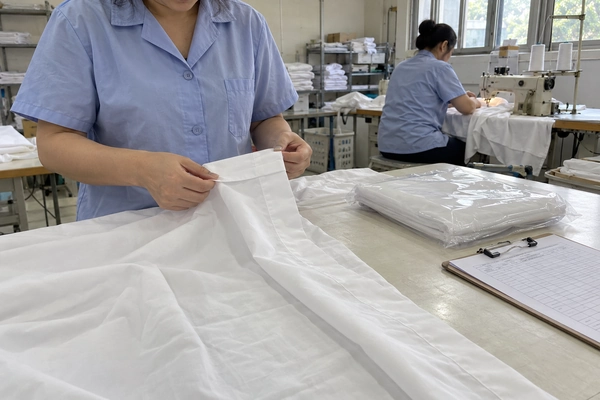
Hotels should choose a best quality bed linen supplier by auditing its technical capability, quality-control process, production capacity, customization support, and delivery record. Buyers should approve sealed samples, define measurable tolerances, verify relevant documents, and run laundering trials before committing to a large opening or replacement order.
What Should a Supplier Audit Cover?
I use supplier evaluation to answer one basic question: Can this factory repeatedly produce what it promised?
A practical audit should examine:
- Yarn and fabric traceability
- Incoming material inspection
- Weaving or approved mill controls
- Fabric defect inspection
- Bleaching and finishing controls
- Shade and whiteness management
- Cutting accuracy
- Sewing-line quality checks
- Needle and metal control where relevant
- Final inspection procedures
- Packing and carton identification
- Complaint handling and corrective action
- Capacity planning and peak-season performance
Certifications can support the assessment, but they do not replace it. Buyers should verify that certificates are current, issued by recognized bodies, and relevant to the actual production site and product scope. Application-specific compliance should be reviewed by qualified testing, legal, or procurement professionals.
Which Questions Should a Buyer Ask?
I recommend asking direct questions that require measurable answers:
- What are the exact warp and weft yarn specifications?
- How does the factory calculate thread count?
- What are the finished size tolerances?
- What shrinkage range does the supplier guarantee?
- Which defects are considered critical, major, or minor?
- Can the supplier provide pre-production and bulk-production samples?
- How does the factory prevent unapproved material substitution?
- Which laundering tests have been completed?
- Can the factory maintain the same specification for repeat orders?
- What happens if a shipment fails the agreed inspection standard?
The answers should appear in the purchase specification, not only in emails or sales presentations.
Why Does One-Stop Supply Matter?
Hotels rarely purchase sheets alone. A new property may need duvet covers, pillowcases, towels, bath mats, bathrobes, mattress protectors, duvets, pillows, table linen, and guest amenities. Multiple suppliers can create inconsistent colors, fragmented deliveries, and more administrative work.
Hotelier was established in Jiangsu in 1999. Our factory has about 300 employees and occupies more than 40,000 square meters. Based on our business records, we have supplied more than 30,000 hotels and worked with properties or programs associated with groups such as Hilton, Marriott, InterContinental, Ritz-Carlton, Four Seasons, Banyan Tree, Crowne Plaza, and Mandarin Oriental. Buyers should verify current references and project scope during procurement.
Our self-developed and self-woven fabric has also been adopted in Marriott-related supply since its approval, according to our records. I mention that experience because it demonstrates the value of development capability and repeat production. It does not mean that one specification fits every Marriott hotel or every hospitality application.
The advantage I try to deliver is a controlled balance between:
- Guest comfort
- Five-star appearance
- Commercial durability
- Stable repeat orders
- Custom branding
- Consolidated procurement
- Practical project cost
That balance often matters more to hotel owners than achieving the highest possible thread count.
Frequently Asked Questions
Is Egyptian cotton always the best quality bed linen?
Egyptian cotton can offer long, fine fibers, but the label alone does not guarantee quality. I recommend verifying fiber authenticity, yarn construction, weave, finishing, and manufacturing consistency. High-grade long-staple cotton from other origins can also produce excellent hotel linen when it is spun and woven correctly.
Is 300 thread count enough for a luxury hotel?
A well-engineered 300 TC fabric can be suitable for a luxury hotel. I would evaluate whether it uses single or two-ply yarn, percale or sateen construction, and controlled finishing. Many buyers find that a stable 300 TC specification gives a better comfort-to-durability balance than an inflated higher count.
How many washes should hotel bed linen last?
Service life depends on the fabric, laundry chemistry, temperature, drying, ironing, stain treatment, and operating standards. Some premium constructions may reach around 200 to 280 controlled commercial washes, but I would not accept a wash-life claim without reviewing the test method and completing a trial in the hotel’s actual laundry system.
Should hotels choose percale or sateen sheets?
I recommend percale when a hotel wants crispness, breathability, and a tailored matte surface. I recommend sateen when the concept requires a smoother feel and subtle sheen. Both can qualify as the best quality bed linen when the yarn, finishing, sewing, and quality controls match the application.
How can I compare bed linen suppliers fairly?
I would send every shortlisted supplier the same specification, size chart, test requirements, and sample request. I would then compare sealed samples after identical laundering. Buyers should also review factory capability, quality procedures, references, lead times, minimum order quantities, replacement policy, and total landed cost.
Conclusion
The best quality bed linen does not come from a country, brand name, or thread-count number alone. I look for fine but appropriate yarns, stable weaving, controlled finishing, accurate sewing, proven laundering performance, and repeatable production. Italian luxury textiles set an important craftsmanship benchmark, while capable Chinese manufacturers can offer excellent quality at a practical commercial cost. If you are sourcing linen for a hotel, resort, rental program, or distribution business, contact Hotelier to request specifications, samples, customization options, and a project-based quotation.
<h6>[^1]: "abstract", https://repository.lib.ncsu.edu/bitstreams/6a0b5dce-6f63-4a2c-897c-b1d3c379e805/download. Textile research indicates that thread count alone does not determine sheet quality because fiber properties, yarn construction, weave, and finishing also influence comfort and durability. Evidence role: general_support; source type: research. Supports: Independent textile evidence should show that fiber quality, yarn construction, weave, and finishing affect sheet performance beyond advertised thread count or price.. Scope note: Such evidence supports the general purchasing principle but does not establish that every expensive or high-thread-count product performs poorly. [^2]: "Publication: Innovation, Investment, and Emerging ...", https://openknowledge.worldbank.org/entities/publication/d863c052-ffaa-58b5-80ba-67eabb5fa72e. International-industry data identify China as a major producer and exporter across multiple stages of the textile value chain, from yarn and fabric to finished textile goods. Evidence role: general_support; source type: institution. Supports: International trade or industrial evidence should document China's substantial capacity across textile production and apparel or finished-goods manufacturing.. Scope note: National production scale does not establish the technical capability, labor practices, or quality consistency of any individual factory. [^3]: "Comparison of Properties of Single Jersey Knit Fabrics ...", https://www.academia.edu/33845490/Comparison_of_Properties_of_Single_Jersey_Knit_Fabrics_Knitted_With_Single_and_Double_Ply_Yarn_of_Same_Resultant_Count. For equal component yarns in the indirect English count system, the nominal resultant count is the component count divided by the number of plies, so 2/80 Ne is approximately 40 Ne before adjustment for folding contraction. Evidence role: mechanism; source type: education. Supports: A yarn-numbering reference should provide the formula for calculating the nominal resultant count of equal folded yarns in an indirect count system.. Scope note: The calculated value is nominal; measured linear density may differ because of ply twist, contraction, moisture, and manufacturing variation. [^4]: "G. Laundry and Bedding | Infection Control", https://www.cdc.gov/infection-control/hcp/environmental-control/laundry-bedding.html. Industrial-laundering standards evaluate textiles through repeated washing and specified drying or finishing procedures, reflecting exposures that are not reproduced by a simple household handling assessment. Evidence role: general_support; source type: institution. Supports: An industrial-laundering standard should document standardized washing, drying, and finishing processes used to assess textiles under commercial conditions.. Scope note: A standardized protocol may not reproduce the exact chemistry, machinery, stain treatment, or handling practices of a particular hotel laundry.</h6>