
What Are the Different Names of Bedding?
The different names of bedding can confuse even experienced hotel buyers because suppliers, housekeepers, and guests often use different terms for the same item. That confusion can cause incorrect quotations, poor bed presentation, and costly order errors. I find that the easiest solution is to identify each bedding component from the top of the bed downward.
The different names of bedding include duvet cover, top sheet, duvet insert, comforter, blanket, flat sheet, fitted sheet, mattress protector, mattress topper, pillow, pillow protector, and pillowcase. The exact combination depends on the hotel’s location, service level, bed-making method, and housekeeping standards.[^1]
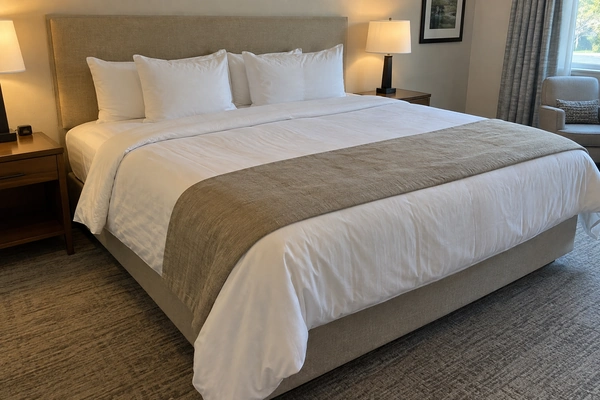
I recommend treating a hotel bed as a layered system rather than a list of isolated textile products. Once I establish the correct order, it becomes much easier to compare terminology, specify dimensions, select materials, and request accurate quotations from bedding suppliers.
What Are the Different Names of Bedding From Top to Bottom?
A hotel bed may look simple after housekeeping finishes it, but several separate products can be hidden under the surface. If a buyer does not define every layer, a supplier may quote a different construction. I therefore begin every bedding discussion by mapping the bed from top to bottom.
The main bedding names from top to bottom are duvet cover or top sheet, duvet insert or blanket, flat or fitted sheet, mattress protector, mattress topper, and mattress. Pillows sit at the head of the bed and normally include pillow inserts, pillow protectors, and pillowcases.
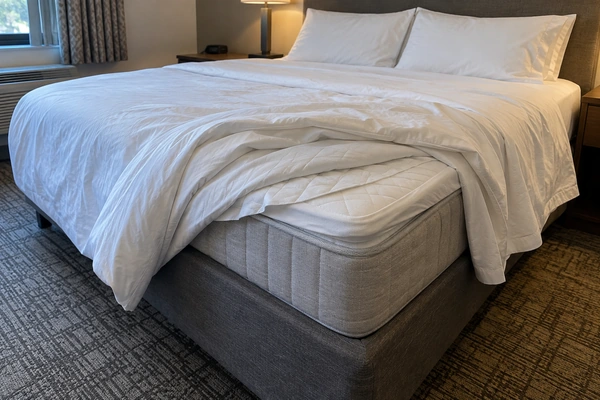
A Practical Top-to-Bottom Bedding List
I commonly organize hotel bedding in this order:
- Decorative throw or bed runner, if required
- Duvet cover, top sheet, coverlet, or bedspread
- Duvet insert, comforter, quilt, or blanket
- Top sheet, depending on the bed-making method
- Fitted sheet or bottom flat sheet
- Mattress protector
- Mattress topper
- Mattress
- Bed base or box spring
Pillows form a separate group:
- Pillow insert
- Pillow protector
- Pillowcase
- Decorative cushion and cushion cover
This order is a useful starting point, but I never assume that every hotel uses every item. American-style hotel beds often use a top sheet as part of a triple-sheeting system. Some properties do not use removable duvet covers. Many European hotels use fitted bottom sheets and separate duvet covers.[^2] Other hotels place blankets between sheets.
Bedding Names Can Vary by Market
A major source of confusion is that several bedding terms overlap. For example, some suppliers use “comforter” and “duvet” interchangeably. However, a comforter may be designed as a finished, washable product, while a duvet insert is generally placed inside a removable duvet cover.
| Bedding layer | Common name | Alternative name | Main purpose |
|---|---|---|---|
| Top decorative layer | Bed runner | Bed scarf | Decoration and surface protection |
| Main upper cover | Duvet cover | Quilt cover | Encloses a removable insert |
| Upper sheet | Top sheet | Flat sheet | Separates the guest from the blanket or insert |
| Insulating layer | Duvet insert | Comforter, quilt, inner | Provides warmth |
| Secondary insulating layer | Blanket | Bed blanket | Adds adjustable warmth |
| Bottom sheet | Fitted sheet | Contour sheet | Covers the mattress with elasticated corners |
| Bottom sheet alternative | Flat sheet | Bottom sheet | Covers the mattress and is tucked underneath |
| Protective layer | Mattress protector | Mattress pad, mattress cover | Protects the topper and mattress |
| Comfort layer | Mattress topper | Bed topper | Changes surface softness and support |
| Pillow cover | Pillowcase | Pillow slip | Provides a washable guest-contact surface |
| Inner pillow cover | Pillow protector | Pillow encasement | Protects the pillow insert |
When I prepare a purchase specification, I use both the preferred product name and a functional description. For example, I might write: “zippered white duvet cover for a 200 × 200 cm insert.” This approach reduces regional misunderstandings.
Which Bedding Names Describe the Top Layers?
The visible top layers control the bed’s appearance, warmth, and housekeeping process. Confusion arises because duvet covers, top sheets, comforters, quilts, and coverlets can look similar in photographs. I separate these bedding names by asking whether the product encloses an insert, touches the guest, or serves mainly as decoration.
The main top-layer bedding names are duvet cover, top sheet, duvet insert, comforter, blanket, quilt, coverlet, and bedspread. A duvet cover encloses an insert, while a top sheet separates the guest from the insulating layer. Coverlets and bedspreads usually provide decoration or light coverage.
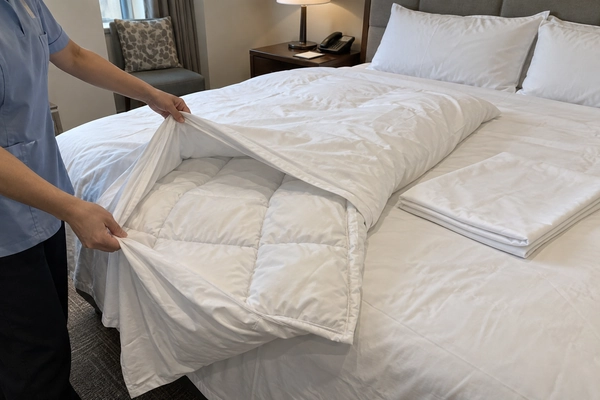
Duvet Cover
A duvet cover is a removable textile shell designed to hold a duvet insert. It usually has an opening at the foot, which may close with buttons, snaps, ties, or a zipper. Hotel duvet covers are often made from white cotton or cotton-rich woven fabric because housekeeping teams need to inspect and launder them frequently.
When I evaluate a duvet cover, I check:
- Finished dimensions after laundering
- Fabric composition
- Thread count and yarn specification
- Weave, such as plain, sateen, or stripe
- Closure type
- Internal ties or insert-retention features
- Shrinkage tolerance
- Seam strength
- Wash temperature and drying requirements
Thread count alone does not establish quality. I also examine yarn size, fabric weight, weave density, finishing, and verified laundering results.
Top Sheet and Triple Sheeting
A top sheet is a flat sheet placed between the guest and a blanket, comforter, or duvet insert. It is also called an upper sheet. In some American hotel bed-making systems, housekeeping teams use three sheets:
- A bottom sheet over the mattress
- A middle sheet under the blanket or insert
- A top sheet folded over the insulating layer
This method is often called triple sheeting. The exact arrangement varies by hotel brand and operating procedure, so I ask buyers for a bed-making diagram instead of relying on the phrase alone.
Duvet Insert, Comforter, and Quilt
A duvet insert is the filled insulating component placed inside a duvet cover. Common filling materials include:
- Down
- Feather and down blends
- Polyester fiber
- Microfiber
- Wool
- Other engineered fillings
A comforter can describe a similar filled product, especially in North America. However, some comforters have finished decorative outer fabrics and are intended for use without a separate cover. A quilt traditionally refers to stitched layers, although commercial suppliers may use the term for several filled constructions.
I recommend specifying the construction instead of selecting an item by name alone. Buyers can compare fill weight, total weight, warmth level, shell fabric, stitching pattern, dimensions, and laundering method. Down and feather products may also require documentation relating to fill composition, cleanliness, traceability, and responsible sourcing. Buyers should verify any certification directly with the issuing body.
Blanket, Coverlet, and Bedspread
A blanket provides warmth and can sit between two sheets or above a top sheet. A coverlet is usually lighter and more decorative. A bedspread commonly extends farther down the sides of the bed and may cover most of the bed base.
These distinctions affect laundry costs. A large decorative bedspread can require more drying time and storage space than a lightweight bed runner.[^3] I therefore compare appearance with housekeeping labor before recommending a top-layer system.
Which Bedding Names Apply to Sheets and Mattress Protection?
Sheets and protective products are easy to overlook because several layers remain hidden after the bed is made. However, these items affect hygiene procedures, mattress life, guest comfort, and housekeeping speed. I use precise bedding names to prevent a mattress topper from being mistaken for a mattress protector.
The main sheet and protection bedding names are flat sheet, fitted sheet, mattress protector, mattress pad, mattress encasement, and mattress topper. A sheet creates the sleeping surface, a protector guards against contamination and moisture, and a topper adds cushioning or changes the feel of the mattress.
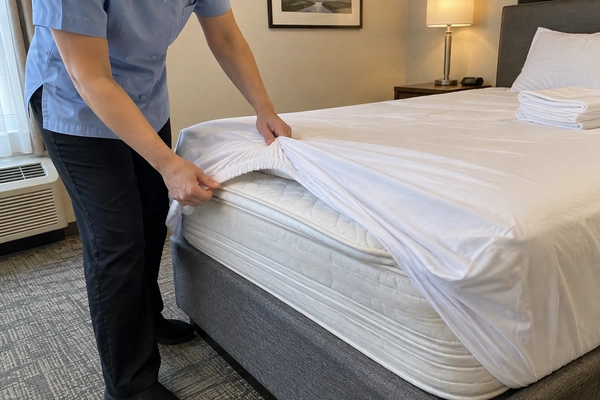
Flat Sheet Versus Fitted Sheet
A flat sheet is a rectangular piece of fabric without elasticated corners. Hotels may use it as either a bottom sheet or a top sheet. When used as a bottom sheet, housekeeping staff tuck it under the mattress.
A fitted sheet has shaped corners and usually includes elastic. It wraps around the mattress. Many European properties use fitted sheets because they can provide a neat fit and simplify bed making. However, the buyer must match the sheet to the mattress dimensions carefully.
I request four measurements for fitted sheets:
- Mattress width
- Mattress length
- Mattress height
- Additional depth created by a topper or pad
A fitted sheet that matches the mattress but ignores a 3–5 cm topper may pull away from the corners. A sheet that is too deep may wrinkle and look loose. Shrinkage after commercial laundering also needs to be included in the sizing decision.
Mattress Topper
A mattress topper is a comfort layer positioned above the mattress. In many hotel applications I encounter, toppers are approximately 3–5 cm thick, although thicker and thinner products are available. Common fills include feather and down blends, polyester fiber, foam, latex, or combinations of materials.
The topper’s main job is to modify surface comfort. It can make a firm mattress feel softer, but it cannot repair a structurally damaged mattress. I advise buyers to evaluate the complete sleep system rather than expecting the topper to correct poor mattress support.
Important topper specifications include:
- Finished thickness
- Fill material and fill weight
- Firmness or loft
- Outer fabric
- Internal baffle or channel construction
- Corner straps
- Washability
- Drying time
- Recovery after compression
Mattress Protector and Mattress Encasement
A mattress protector sits above the mattress or over both the mattress and topper. The exact setup depends on the protector’s depth and the hotel’s operating standard. A fitted protector can help hold the topper and mattress together as one unit.
A mattress encasement surrounds the entire mattress and usually closes with a zipper. An encasement provides more complete coverage than a fitted protector. However, buyers should not assume that every protector is waterproof, breathable, allergen-resistant, or suitable for a particular hygiene protocol.
| Product | Primary function | Typical fitting style | Key procurement check |
|---|---|---|---|
| Mattress topper | Adds cushioning | Straps or fitted skirt | Thickness and recovery |
| Mattress pad | Adds light cushioning and protection | Fitted skirt | Fill weight and washability |
| Mattress protector | Protects sleep surface | Fitted or strapped | Liquid barrier and breathability |
| Mattress encasement | Covers the full mattress | Zippered enclosure | Seam and zipper construction |
I ask suppliers for test reports that correspond to the exact material and construction being quoted. Buyers should verify claims about waterproofing, flame performance, allergen barriers, or antimicrobial treatments. Qualified professionals should assess products against local regulations and the property’s application-specific risks.
What Are the Different Names of Bedding for Pillows?
Pillow terminology appears straightforward until a hotel needs several sizes, firmness levels, and protection methods. An order that states only “hotel pillows” leaves too many decisions open. I define the pillow insert, protector, pillowcase, dimensions, filling, and firmness as separate parts of the bedding specification.
The main pillow-related bedding names are pillow insert, bed pillow, pillow protector, pillowcase, pillow sham, bolster, and decorative cushion. A pillow insert provides support, a protector creates an inner protective layer, and a pillowcase forms the removable guest-contact surface.
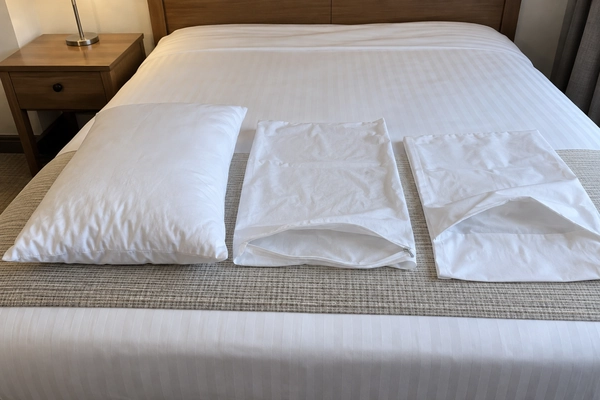
Pillow Insert
The pillow insert is the filled inner product. It may also be called a bed pillow or pillow inner. Common filling options include polyester fiber, microfiber, down, feather blends, foam, latex, and hybrid constructions.
A higher-end king room often has at least four sleeping pillows. One common arrangement uses:
- Two lower or softer pillows
- Two higher or firmer pillows
This arrangement gives guests a basic choice of loft and support. However, I do not treat four pillows as a universal standard. The final quantity should reflect bed width, brand standards, room category, storage, and laundry operations.
Pillow Protector
A pillow protector fits between the pillow insert and the pillowcase. It may use a zipper, envelope opening, or other closure. Higher-end hotels often add protectors to improve operational hygiene and reduce direct exposure of the pillow insert to body oils and moisture.
I compare pillow protectors by:
- Fabric composition
- Closure construction
- Breathability
- Moisture resistance
- Seam quality
- Shrinkage
- Commercial wash compatibility
- Noise during movement
A protector with a strong liquid barrier may still be unsuitable if it traps heat or produces noticeable noise. Sampling and sleep trials can reveal these issues before a bulk order.
Pillowcase, Pillow Sham, and Cushion Cover
A pillowcase is the washable outer cover used for sleeping pillows. It may have an open end, envelope flap, or decorative border. A pillow sham usually has a more decorative purpose and may feature flanges around the edges. A cushion cover is designed for decorative cushion inserts rather than standard sleeping pillows.
Dimensions require special attention. “King pillow” and “standard pillow” can refer to different measurements in different markets.[^4] I always list finished dimensions in centimeters or inches instead of relying only on size names.
How I Specify Hotel Pillows
I use a specification line that resembles this example:
> Bed pillow, 50 × 90 cm finished size, medium-firm polyester microfiber filling, specified fill weight, downproof cotton-rich shell, double-stitched seams, commercial-laundry compatible.
The buyer should then request samples and evaluate loft, compression recovery, heat retention, odor, noise, support, and appearance inside the selected pillowcase. A supplier’s certificates can support due diligence, but buyers should confirm their scope, validity, and connection to the supplied batch or product.
How Should Buyers Use Bedding Names in a Purchase Specification?
Knowing common terminology does not guarantee an accurate order. Suppliers can interpret familiar words differently, especially when the buyer and factory work in different markets. I avoid relying on bedding names alone. I combine each term with dimensions, material requirements, construction details, performance expectations, and approved samples.
Buyers should use bedding names as product labels and then add measurable specifications. A complete hotel bedding request should define size, fabric composition, weave, weight, filling, closure, color, shrinkage tolerance, laundering conditions, packaging, quantity, and required testing documents.
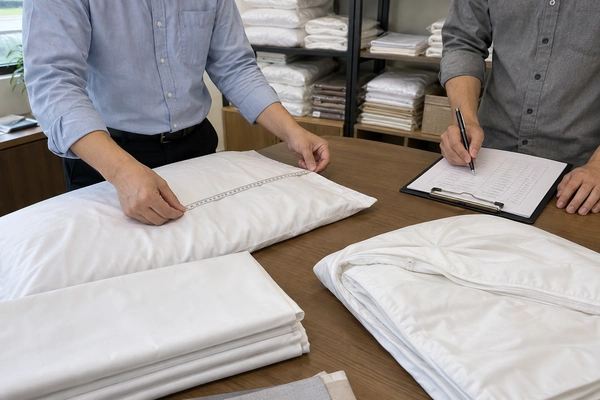
Build a Room-by-Room Bedding Schedule
I recommend creating a schedule for every bed type. The schedule should list all components and quantities per room.
| Specification field | Example information |
|---|---|
| Bed type | King |
| Mattress dimensions | 180 × 200 × 30 cm |
| Topper dimensions | 180 × 200 × 5 cm |
| Bottom sheet | Fitted, suitable for combined depth |
| Top sheet | Flat sheet, defined finished dimensions |
| Insulating layer | Duvet insert with stated fill weight |
| Upper cover | Duvet cover with foot opening |
| Pillow arrangement | Two soft and two firm pillows |
| Protection | Mattress and pillow protectors |
| Replacement allowance | Defined by opening and operating plan |
The buyer should also separate room par from total order quantity. Many hotels maintain multiple sets for each bed so that one set can be in use, another can be in laundry, and another can be available as backup. The correct par level depends on occupancy, laundry turnaround, loss rates, storage, and operational policy.
Evaluate Samples Under Real Conditions
I do not consider a visual inspection sufficient. A white sheet may look excellent before washing but shrink, twist, pill, or lose smoothness after repeated processing.
A practical evaluation can include:
- Recording pre-wash dimensions and weight
- Washing under the proposed commercial-laundry conditions
- Measuring dimensional change
- Inspecting seams, hems, closures, and color
- Checking pilling and surface appearance
- Testing fit on the actual mattress and topper
- Asking housekeeping staff to make the bed
- Comparing drying and finishing time
At Hotelier, we have manufactured hotel linen and amenities in Jiangsu since 1999. Our supplied business context includes a factory of more than 40,000 square meters, around 300 employees, and supply relationships with over 30,000 hotels. It also states that our self-developed woven fabric has been adopted by Marriott and that selected five-star linen is designed to withstand 280 washes.
I present those details as supplier context rather than a substitute for evaluation. Buyers should ask which exact product achieved a stated wash result, which wash formula was used, and whether an independent report is available. Actual service life can change with chemistry, temperature, extraction, drying, finishing, stain treatment, and guest use.
Frequently Asked Questions
Is bedding the same as bed linen?
Bedding is the broader term. It can include sheets, duvet inserts, blankets, toppers, protectors, pillows, and decorative covers. Bed linen usually refers to washable textile covers, such as sheets, duvet covers, and pillowcases. Suppliers may use both terms differently, so I recommend listing individual products.
What is the difference between a duvet and a comforter?
A duvet usually refers to an insert placed inside a removable duvet cover. A comforter may have a finished outer shell and can sometimes be used without a separate cover. I advise buyers to confirm the intended bed-making method, filling, shell fabric, and laundering process.
Does a mattress protector go over a mattress topper?
A fitted mattress protector can go over both the mattress topper and mattress, which helps create one combined sleeping unit. However, the protector must have enough pocket depth. Some hotels protect the mattress and topper separately, so I follow the property’s hygiene and housekeeping requirements.
Is a flat sheet the same as a top sheet?
A top sheet is normally a flat sheet placed above the guest and below a blanket or other insulating layer. A flat sheet can also serve as the bottom sheet when it is tucked around the mattress. The term “flat sheet” describes its construction, while “top sheet” describes its position.
How many pillows should a hotel king bed have?
A king bed often has at least four sleeping pillows, including two lower pillows and two higher pillows. Some luxury hotels add decorative cushions or additional firmness options. I recommend matching the number to the property’s brand standard, bed width, room category, storage capacity, and laundry budget.
Conclusion
The different names of bedding become easier to understand when I organize every item from the top layer down to the mattress. Duvet covers, top sheets, inserts, blankets, fitted sheets, protectors, toppers, pillows, and pillowcases each perform a different job. Clear terminology is only the first step, however. Buyers should also verify dimensions, materials, construction, laundering performance, and supplier documents. If you need a coordinated hotel bedding schedule, samples, or a one-stop linen and amenities quotation, contact Hotelier with your room and mattress specifications.
[^1]: "Hotel Hygiene: Standards, Practices & Guest Expectations", https://insights.ehl.edu/hotel-hygiene. [^2]: "Bed Bugs | Ohioline - The Ohio State University", https://ohioline.osu.edu/factsheet/hyg-2105. fects of fabric - Open Research Oklahoma", https://openresearch.okstate.edu/server/api/core/bitstreams/e15b46c1-47d0-4487-a157-e523a1aebf9c/content. [^4]: "Linens • International Students and Scholars - Lclark", https://www.lclark.edu/offices/international/admitted/packing/linen/.