Why Is Hotel Linen White?
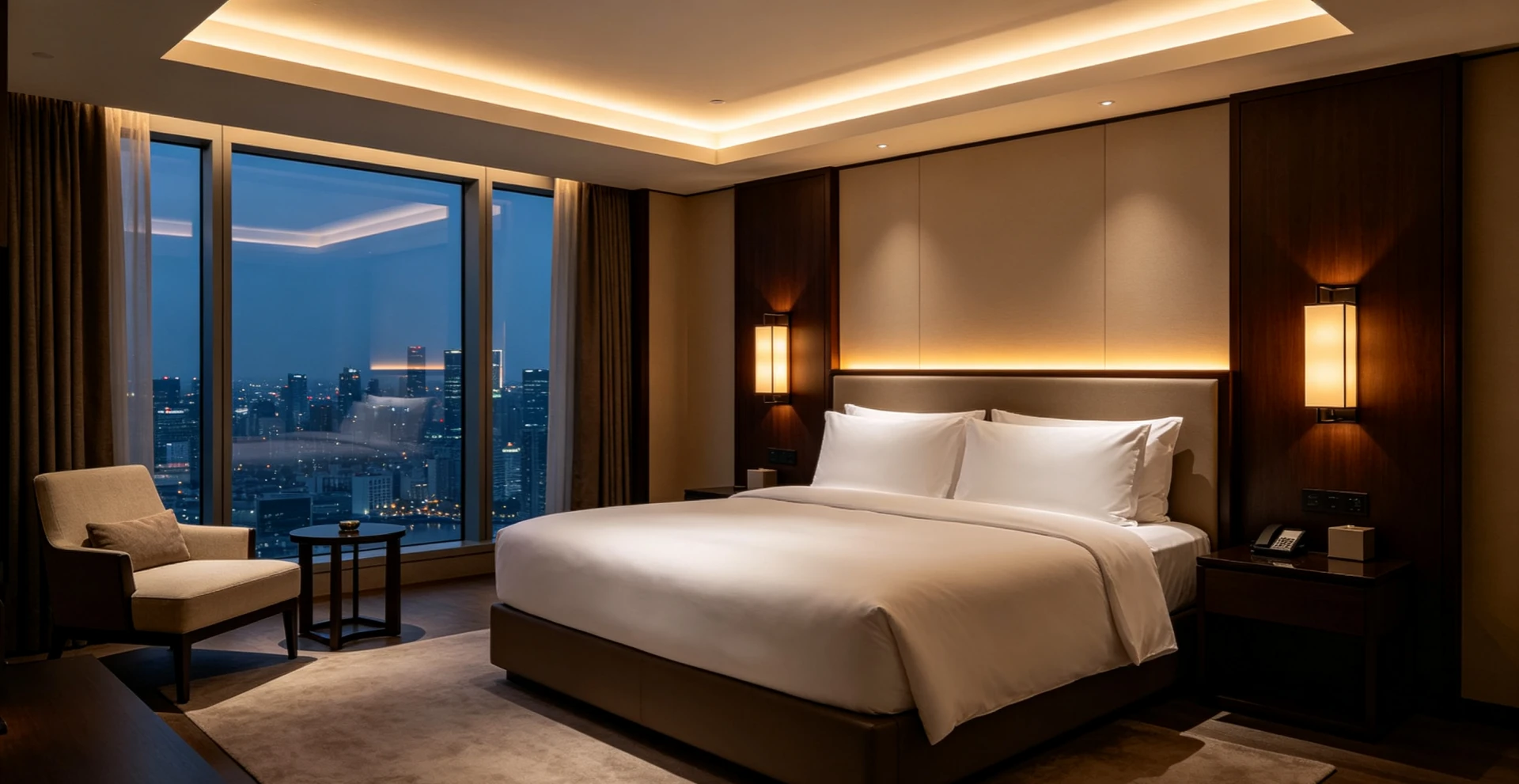
Hotel linen is usually white because hotels face a problem that homes rarely encounter: thousands of sheets, pillowcases, and towels must move through repeated use, washing, inspection, and replacement. Colored collections can increase sorting and matching complexity. White gives hotel operators a familiar, standardized system that is easier to manage.
Hotel linen is white mainly because one standard color simplifies laundering, sorting, inspection, inventory pooling, and replacement. White also creates a consistent appearance that guests recognize across hotel rooms and locations. It is not automatically more hygienic, but stains, discoloration, and visible wear are generally easier for staff to identify.
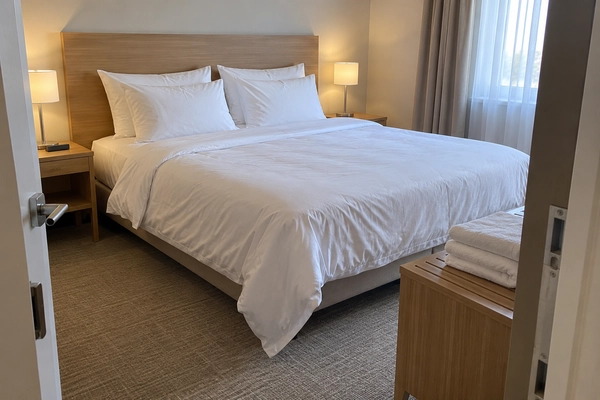
In hotel linen procurement, I encourage buyers to look beyond appearance. The better question is whether a color supports the property’s laundry cycle, replacement plan, room design, and brand standards. Those operational details explain why white remains dominant and when another color may still make sense.
Why Does White Hotel Linen Simplify Daily Operations?
Hotel operators need linen to move quickly from guest rooms to collection carts, laundries, inspection areas, storage rooms, and back to housekeeping. When properties use many colors, patterns, or shades, each step can become more complicated. Small variations can eventually create visible inconsistencies.
White hotel linen simplifies daily operations because a standard color is easier to sort, match, store, pool, and replenish. Housekeeping teams can usually combine compatible white items by product type and specification instead of maintaining separate color collections. This approach can reduce mismatched sets and support more consistent room presentation.
Hotels Manage Linen as a Circulating System
I often explain that a hotel does not use bedding in the same way that a household does. A household may wash one sheet set and return it to the same bed. A hotel usually operates a circulating inventory.[^1]
A typical cycle includes:
- Housekeeping removes used linen from the room.
- Staff collect and transport the items.
- An on-site or commercial laundry sorts the linen.
- The laundry washes and finishes each compatible load.
- Staff inspect the clean items.
- Housekeeping stores or redistributes the linen.
- Damaged or unacceptable pieces leave circulation.
- The purchasing team replenishes the missing stock.
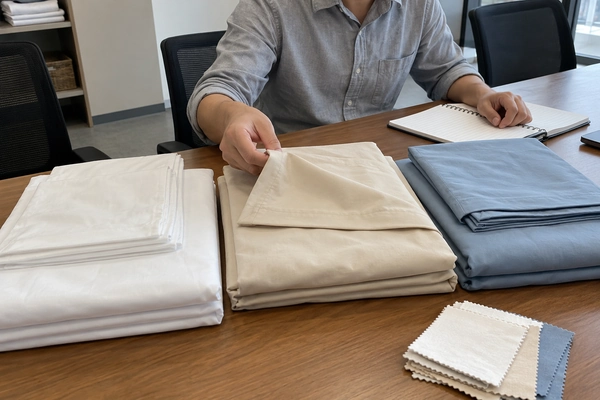
Color affects every stage. If a hotel uses several tones of beige, gray, blue, and white, the laundry may need additional sorting controls. The storeroom may also need separate stock-keeping units. Housekeepers must then select the correct shade for each room type.
Standardization Reduces Matching Problems
White does not eliminate every matching problem. Different fabrics, thread constructions, finishing treatments, and product ages can still create variations. However, a controlled white-linen program gives buyers a simpler starting point.
I advise purchasers to standardize more than color. A useful specification should also cover:
- Fiber composition
- Fabric construction
- Finished dimensions
- Fabric weight or thread specification
- Whiteness tolerance
- Shrinkage tolerance
- Seam and hem construction
- Care instructions
- Room or property allocation
- Replacement compatibility
A “white sheet” is not one universal product. An optical white can look different from a warmer white. Cotton sateen can reflect light differently from cotton percale. Repeated laundering can also change the appearance of new and older pieces.
| Operational factor | One controlled white program | Multiple colors or shades |
|---|---|---|
| Laundry sorting | Usually simpler | Often requires more separation |
| Storeroom organization | Fewer color categories | More color-specific categories |
| Replacement matching | Generally easier | Shade matching may be difficult |
| Room presentation | More uniform | More dependent on accurate picking |
| Cross-room pooling | Often practical | May be limited by design |
| Supplier changes | Still requires sample approval | Color continuity can be more difficult |
From my procurement perspective, white is therefore a management choice before it is an aesthetic choice. The value comes from reducing variables in a system that repeats every day.
Why Is White Hotel Linen Easier to Inspect?
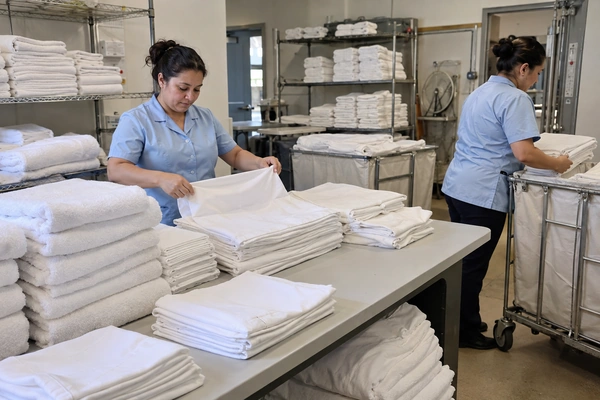
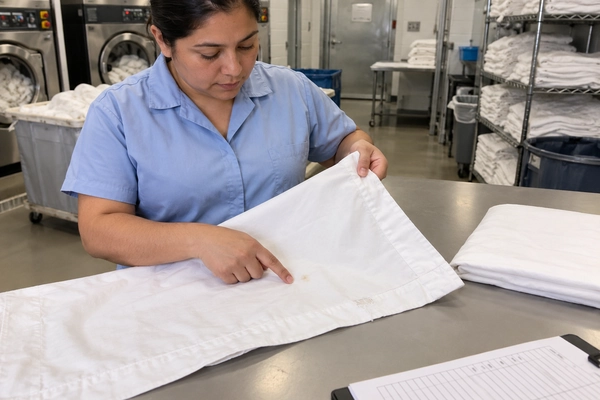
Hotels need to decide whether each returned item is ready for another guest. Staff can miss marks, discoloration, or wear when fabric colors conceal them. White creates a high-contrast background that often makes visible condition problems easier to notice during inspection.
White hotel linen is easier to inspect because stains, yellowing, color transfer, and some forms of wear usually stand out against a light surface. This visibility helps staff identify items that require rewashing, stain treatment, repair, or removal. However, visible whiteness does not prove that linen is hygienically clean.
Visibility Supports Quality Control
I treat visual inspection as one part of linen quality control, not as a complete hygiene assessment. White fabric can reveal many common problems, including:
- Makeup and cosmetic residue
- Food and beverage marks
- Oil-based stains
- Rust-colored spots
- Dye transfer
- Localized yellowing
- Scorching or finishing damage
- Frayed edges
- Open seams
- Pilling or surface damage
A darker sheet may hide some of these problems from a quick visual check. That feature may seem convenient, but it can also make condition grading less consistent.
White has the opposite effect. It exposes presentation problems sooner. The hotel may then remove an item even when the fabric remains structurally usable. For an upscale property, that decision can protect room consistency. For a budget property, managers may use a different grading threshold.
White Does Not Automatically Mean Clean
I always separate appearance, cleanliness, and hygiene assurance.
- Appearance concerns stains, shade, wrinkles, damage, and presentation.
- Cleanliness concerns whether washing has removed unwanted soil and residue.
- Hygiene assurance depends on a controlled process, suitable chemistry, equipment, handling, and verification.
A white item can look bright while still having been handled incorrectly. A colored item can be properly processed even if visual inspection is more difficult. Hotels should therefore avoid using whiteness as the only quality indicator.
Laundry professionals should define suitable wash formulas for the fabric, soil type, equipment, water conditions, and local requirements. Hotel buyers should ask qualified laundry specialists to assess application-specific questions. I do not treat a general product specification as a substitute for professional laundry-process evaluation.
Buyers Need an Inspection Standard
I recommend that buyers create a documented acceptance standard. The standard can define:
- Which stains trigger rewashing
- Which defects require repair
- Which shade changes are unacceptable
- When fraying requires removal
- How staff compare old stock with replacement stock
- Who approves downgraded or discarded linen
That process makes decisions more consistent. White hotel linen supports the process because staff can often see defects clearly, but the written inspection standard provides the real operational control.
How Does White Hotel Linen Support Inventory and Replacement?
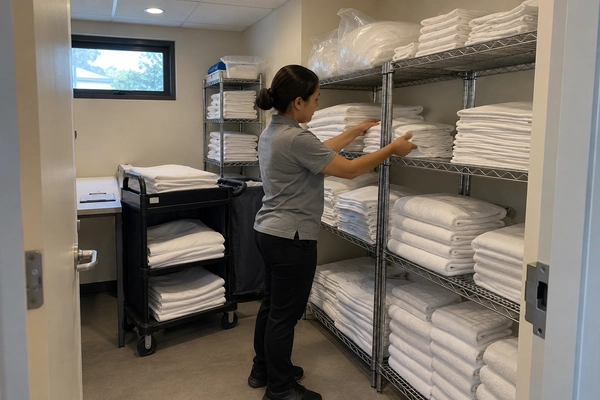
A hotel’s linen collection changes constantly. Pieces become stained, damaged, lost, or unsuitable for guest use.[^2] If replacement products do not match existing stock, rooms can look inconsistent. A fragmented color program makes replenishment harder, especially when suppliers or design collections change.
White hotel linen supports replacement because hotels can often add compatible pieces without recreating a discontinued decorative color. A controlled white specification also allows stock to be pooled across similar rooms or properties. Buyers must still verify shade, fabric construction, dimensions, shrinkage, and finishing before approving replenishment orders.
Replenishment Is a Long-Term Requirement
I have seen buyers focus heavily on the first room installation while giving less attention to the second or third replenishment order. That approach can create problems later.
A hotel may purchase all its opening linen from one production batch. Several months later, the purchasing team may need only fitted sheets or pillowcases. The original product may have changed, or the supplier may interpret “white” differently in the new order.
Hotels should keep a reference specification and, where practical, an approved sample. Buyers can then compare future production against the accepted standard.
I suggest that a replenishment file include:
- Product name and internal stock code
- Bed or bathroom allocation
- Finished size and dimensional tolerance
- Fiber and fabric construction
- Approved white shade
- Hem, seam, and closure details
- Label content and placement
- Care requirements
- Packaging quantity
- Pre-shipment inspection criteria
Pooling Can Reduce Complexity
A standardized white program can allow compatible items to move between room categories or properties. The exact degree of pooling depends on size, quality tier, branding, ownership model, and laundry arrangements.
For example, a hotel group may use the same white pillowcase across several room categories while selecting a higher specification for suites. Another group may standardize sheets across multiple properties but use decorative runners and cushions to differentiate the brands.
This approach separates operational linen from decorative identity. Hotels can keep the high-turnover sheets and pillowcases simple while expressing brand character through lower-turnover elements.
I usually advise buyers to place strong visual identity in items that do not create unnecessary laundry and replenishment complexity.
Cost Claims Require Caution
Standardization can reduce operational complexity, but I avoid promising a fixed percentage of savings. Actual cost depends on occupancy, par levels, labor, laundry contracts, loss rates, product lifespan, and purchasing terms.
Buyers can compare options with a total-cost model:
| Cost category | Questions buyers should ask |
|---|---|
| Initial purchase | What is the unit price at the required specification? |
| Laundry handling | Will the color require separate sorting or special processing? |
| Inventory | How many separate stock categories are needed? |
| Replenishment | Can the supplier reproduce the product consistently? |
| Reject rate | How quickly will visible condition changes remove items from use? |
| Labor | Will housekeeping need extra matching or room-specific picking? |
| Supplier risk | Is the specification documented and transferable? |
White hotel linen does not guarantee lower costs. It simply removes one source of variation, which can make costs easier to control.
Why Do Guests Expect Hotel Linen to Be White?
Travelers enter hotel rooms with expectations formed by past stays, brand imagery, online booking photographs, and hospitality conventions. Unfamiliar bedding colors can be attractive, but they can also change how guests interpret the room. White has become an internationally recognizable visual language for hotel bedding.
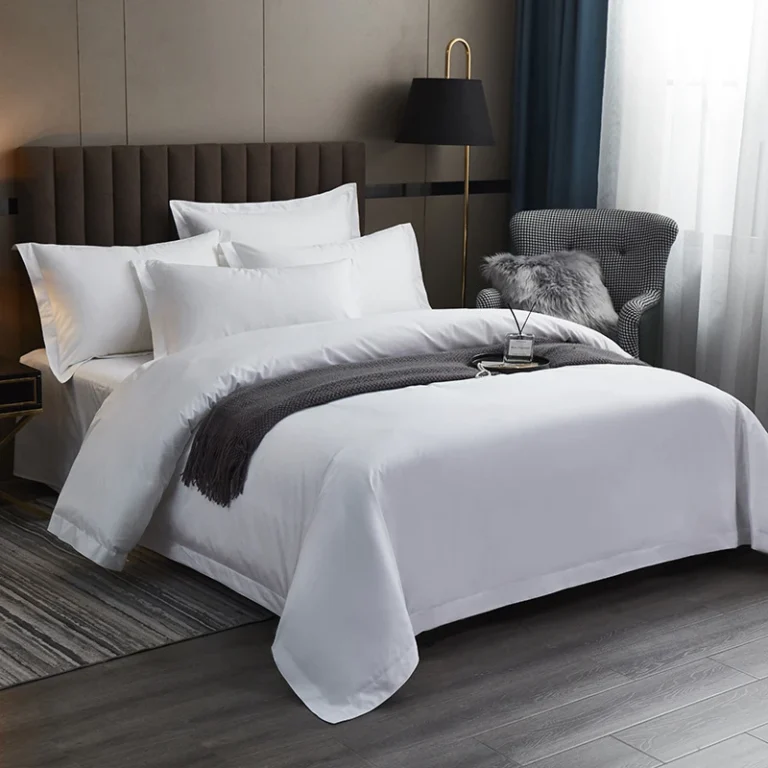
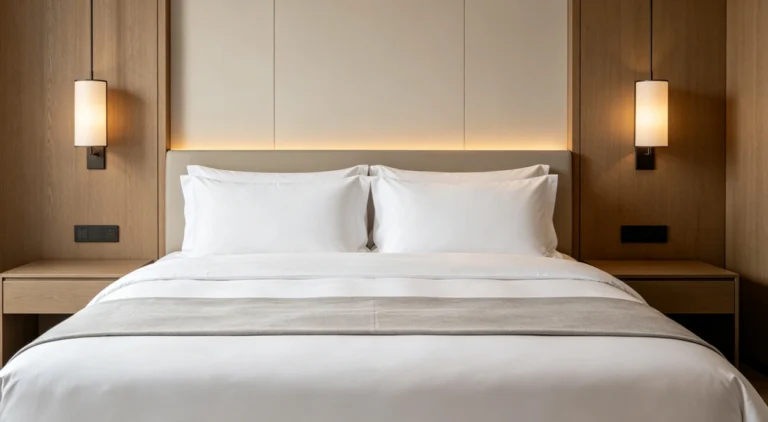
Guests often expect hotel linen to be white because the color has become a shared hospitality convention. White bedding creates a familiar, neutral appearance across different room styles and locations. It can communicate visible order and consistency, although it does not by itself prove quality, luxury, cleanliness, or hygiene.
White Creates a Neutral Visual Base
I view white as a flexible background rather than a complete design statement. It works with many materials and room palettes, including:
- Dark timber and leather
- Pale wood and natural stone
- Bright boutique-hotel colors
- Traditional patterned carpets
- Minimalist interiors
- Metallic or glass finishes
- Seasonal decorative accents
A property can update cushions, throws, artwork, or runners without replacing every sheet and duvet cover. That flexibility matters when hotels renovate rooms in phases.
White also photographs consistently when lighting, camera settings, and editing are controlled. Since guests often make booking decisions from images[^3], a recognizable bed presentation can help connect the online promise with the physical room.
Brand Consistency Matters Across Locations
Hotel chains usually want guests to recognize core parts of the stay, even when architecture and local decoration differ. Bedding is one of those repeated touchpoints.
A global or regional group may use a controlled white bedding system because it supports:
- Similar room presentation across properties
- More consistent brand photography
- Standard operating procedures
- Central procurement specifications
- Easier staff training
- More predictable guest expectations
In our own experience supplying hotel linen from Jiangsu since 1999, customers often discuss repeatability as much as appearance. Buyers want to know whether future orders can align with approved construction, sizing, and performance requirements. I regard those questions as essential because a good sample has limited value if the supplier cannot manage ongoing production.
White Is Not Only a Luxury Signal
Premium hotels commonly use white bedding, but white does not automatically make a room luxurious. Fabric quality, fit, finishing, mattress presentation, laundering, and housekeeping execution all influence the guest experience.
A poorly sized white sheet can look careless. A rough or damaged white duvet cover can feel low quality. In contrast, a carefully selected colored textile may suit a distinctive boutique property.
I therefore avoid treating color as a shortcut for quality. Hotels should evaluate the complete product and operating system.
Is White Hotel Linen Right for Every Property?
White is a strong default, but it is not mandatory. Boutique hotels, resorts, heritage properties, and serviced apartments may use color to strengthen a specific design concept. However, every alternative introduces practical questions about laundering, fading, replacement matching, and long-term availability.
White hotel linen is appropriate for many properties that prioritize standardization, easy inspection, flexible replacement, and familiar guest presentation. Colored linen can still work when a hotel has a clear brand reason, controlled laundry procedures, dependable suppliers, and a realistic replenishment plan. Buyers should compare lifecycle requirements before deciding.

Buyers Should Start With the Operating Model
I recommend that buyers answer operational questions before selecting color. A design team may prefer a distinctive shade, but the housekeeping and laundry teams must manage that choice for years.
The evaluation should cover:
- Will the hotel use an on-site or outsourced laundry?
- Can the laundry segregate colors reliably?
- How many room types need separate products?
- Will several properties share inventory?
- How often will the design concept change?
- Can the supplier reproduce the shade?
- How will fading or color transfer be assessed?
- Will replacement pieces match older inventory?
- What happens if the fabric or dye becomes unavailable?
- Can staff identify unacceptable condition consistently?
White and Colored Linen Have Different Risks
| Selection | Potential advantages | Procurement concerns |
|---|---|---|
| White linen | Familiar, flexible, easy to inspect, easier to standardize | Shade variation, yellowing, visible stains, specification differences |
| Light neutral linen | Softer visual identity, can support boutique design | Replacement shade matching, discoloration, separate stock |
| Dark colored linen | Strong visual effect, may conceal some marks | Fading, dye transfer, inspection difficulty, laundry segregation |
| Patterned linen | Distinctive brand presentation | Pattern continuity, higher matching complexity, limited pooling |
| White linen with decorative accents | Operational base with brand flexibility | Extra accessory handling and replacement planning |
Buyers Should Test Before Committing
I prefer a structured product trial over a decision based only on a showroom sample. A sample can show color and hand feel, but it cannot fully represent repeated operational use.
A buyer can ask the supplier and laundry partner to evaluate:
- Dimensional change after agreed wash cycles
- Shade stability
- Surface appearance
- Seam and hem condition
- Wrinkling and finishing behavior
- Compatibility with existing laundry processes
- Visual matching with current inventory
- Comfort after laundering
Hotels should agree on the testing method before interpreting performance claims. Wash-count statements can differ depending on chemistry, equipment, temperature, drying, finishing, use conditions, and rejection criteria.
Our business produces linen for middle- and upper-tier hotel customers, and we have developed fabrics for long-term hotel use. However, I still advise each buyer to verify samples, specifications, test documents, and relevant supplier claims. A named customer relationship or certification document should support due diligence, not replace it.
A Hybrid Approach Often Works
Some hotels use white sheets, pillowcases, and duvet covers while adding color through:
- Bed runners
- Throws
- Cushions
- Headboards
- Robes
- Towels in selected areas
- Embroidery or woven brand details
This hybrid model preserves much of the operational simplicity of white hotel linen while allowing the room to express a stronger identity. Buyers should still consider cleaning frequency, storage, and replacement needs for every decorative item.
Frequently Asked Questions
Does white hotel linen mean that it is cleaner?
No. White hotel linen can make stains, discoloration, and some forms of wear easier to see, but color does not prove cleanliness or hygiene. Hotels need controlled washing, correct handling, inspection procedures, and appropriate professional verification. I treat whiteness as a visibility aid rather than a hygiene certificate.
Why do hotels use white sheets instead of patterned sheets?
Hotels often use white sheets because one neutral color simplifies sorting, matching, room presentation, and replenishment. Patterned sheets can support a distinctive design, but they may require separate inventory and exact pattern matching. I recommend that buyers assess long-term availability before selecting a pattern.
Are white hotel sheets easier to replace?
White sheets are often easier to replace than products in a custom color or pattern. However, buyers still need to match the shade, construction, size, finish, and expected shrinkage. I recommend keeping an approved product specification and physical reference sample for future replenishment orders.
Can boutique hotels use colored hotel linen?
Yes. Boutique hotels can use colored linen when the choice supports a clear brand concept and the operation can manage sorting, fading, shade matching, and replacement. I suggest testing the product through the intended laundry process and confirming that the supplier can reproduce the color consistently.
What should buyers check when selecting hotel linen?
Buyers should check fiber composition, fabric construction, finished size, shrinkage, seams, hems, shade consistency, care requirements, test methods, packaging, replenishment capability, and quality-control procedures. I also recommend evaluating supplier capacity and requesting verifiable documentation for certifications or performance claims.
Conclusion
Hotel linen is usually white because hotels need a repeatable system for laundering, inspection, inventory control, room presentation, and replacement. White supports those needs without being mandatory, automatically luxurious, or proof of hygiene. I recommend that buyers choose color only after reviewing laundry cycles, stock categories, replenishment risks, and brand requirements.
If you are planning a new property, renovation, or chain-wide linen standard, Hotelier can help you evaluate hotel linen specifications, samples, one-stop room supply requirements, and long-term replenishment needs before you place an order.
[^1]: "Care Strategies of Linen and Guest Satisfaction among ...", https://www.academia.edu/124253489/Care_Strategies_of_Linen_and_Guest_Satisfaction_among_Hotels_in_Upper_East_Region_of_Ghana. Hospitality housekeeping texts characterize linen as circulating stock that moves between rooms, soiled-linen collection, laundry processing, clean storage, and reissue, commonly managed through par-level controls. Evidence role: definition; source type: education. Supports: A hospitality-management source should define hotel linen as circulating stock and describe its movement through use, collection, laundry, storage, and reissue.. [^2]: "(DOC) o o THE LINEN ROOM oo", https://www.academia.edu/4611432/o_o_THE_LINEN_ROOM_oo. Hotel housekeeping research treats loss, staining, physical damage, and quality rejection as recurring causes of linen attrition that must be reflected in par levels and replenishment planning. Evidence role: general_support; source type: research. Supports: Hospitality operations research should document linen losses, damage, rejection, and replacement as routine components of hotel inventory management.. Scope note: Attrition rates are property-specific and vary with occupancy, laundry practices, textile quality, guest behavior, and inventory controls. [^3]: "Effects of Hotel Website Photographs and Length of Textual ...", https://stars.library.ucf.edu/ucfscholar/894/. Empirical tourism research finds that hotel imagery contributes to destination or property evaluation and can influence booking intention alongside price, reviews, location, and other information. Evidence role: general_support; source type: paper. Supports: Empirical hospitality research should show that hotel images affect perceived quality, trust, attitude, or booking intention.. Scope note: Images are only one component of booking decisions, and the evidence does not establish that white bedding itself causes a reservation.