What Bedding Do 5 Star Hotels Use?
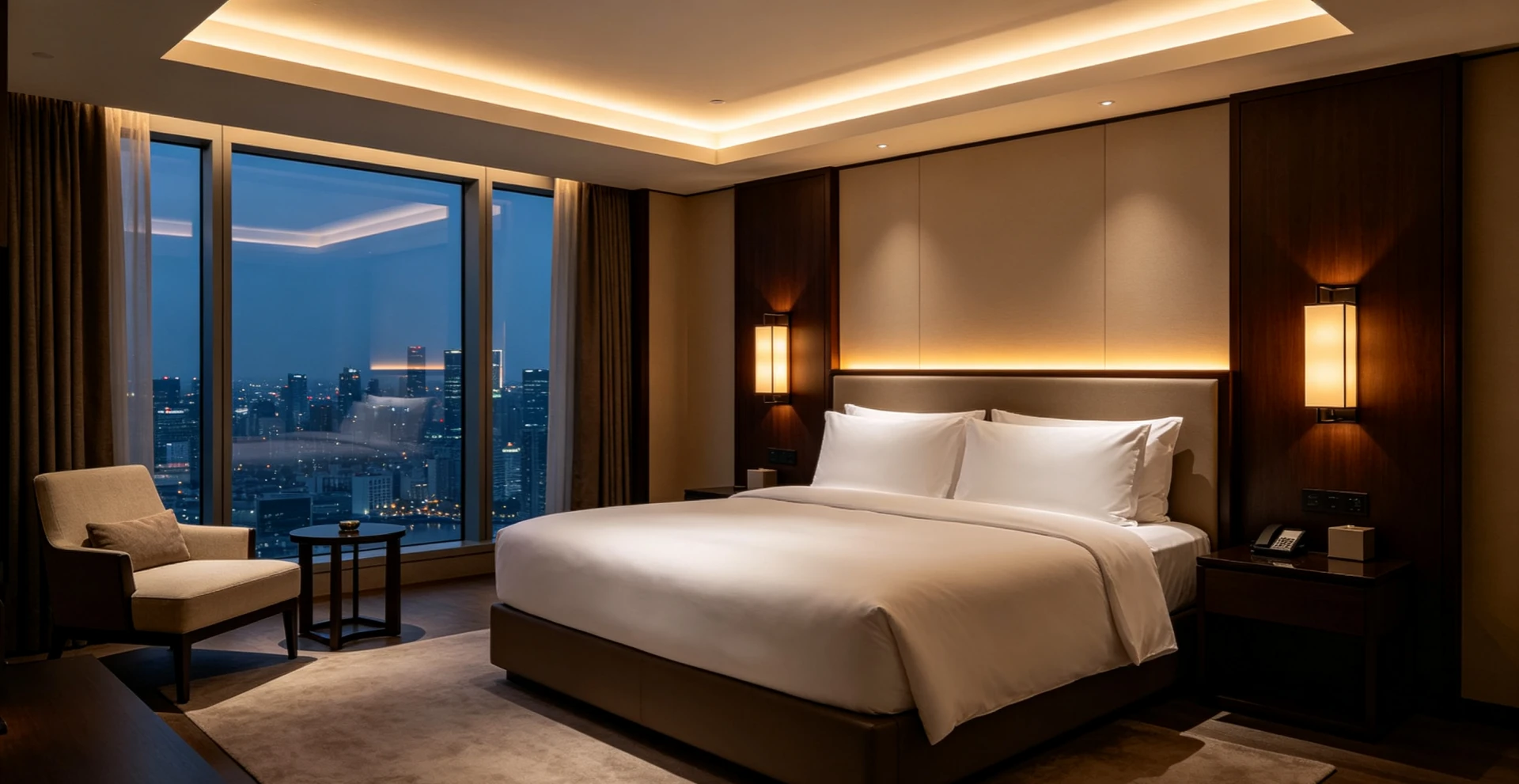
5 star hotel bedding usually combines high-quality cotton sheets, supportive pillows, a premium duvet, and several protective layers. However, inconsistent thread-count claims and regional standards can make procurement difficult. I recommend evaluating the complete sleep system rather than choosing linens from one specification alone.
Most five-star hotels use 100% cotton sheets, often between 350 and 600 thread count, with higher specifications common in Europe and the Middle East. They also typically use down or down-alternative duvets, multiple pillow options, mattress protectors, waterproof layers, and mattress toppers to balance comfort, hygiene, and durability.
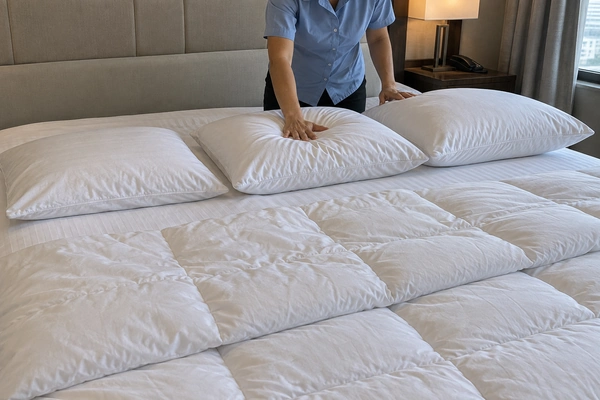
I have found that the visible sheet is only one part of a luxury hotel bed. Buyers also need to compare yarn quality, weave, filling material, laundering performance, mattress protection, and supplier consistency. The following sections explain how these elements work together.
What Types of Bedding Do 5 Star Hotels Use?
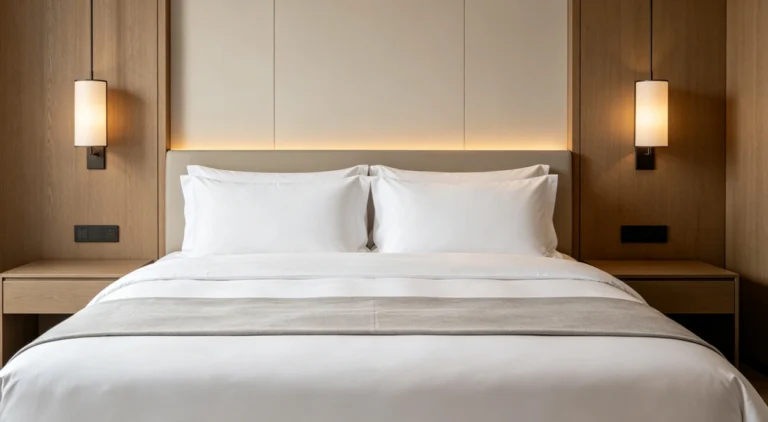
A luxury bed can look simple, but its construction involves several coordinated products. If one component performs poorly, guests may notice heat, noise, wrinkles, or inadequate support. I therefore assess 5 star hotel bedding as a layered system rather than as a sheet set.
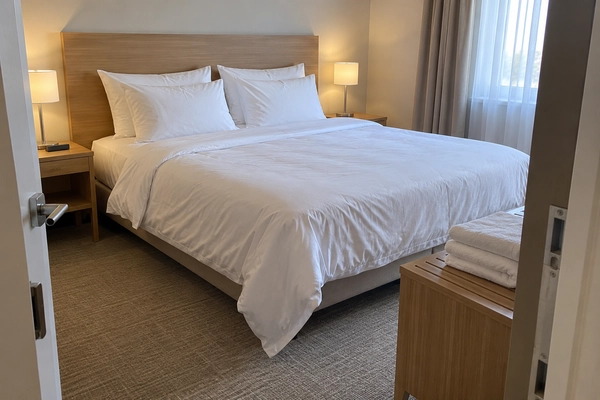
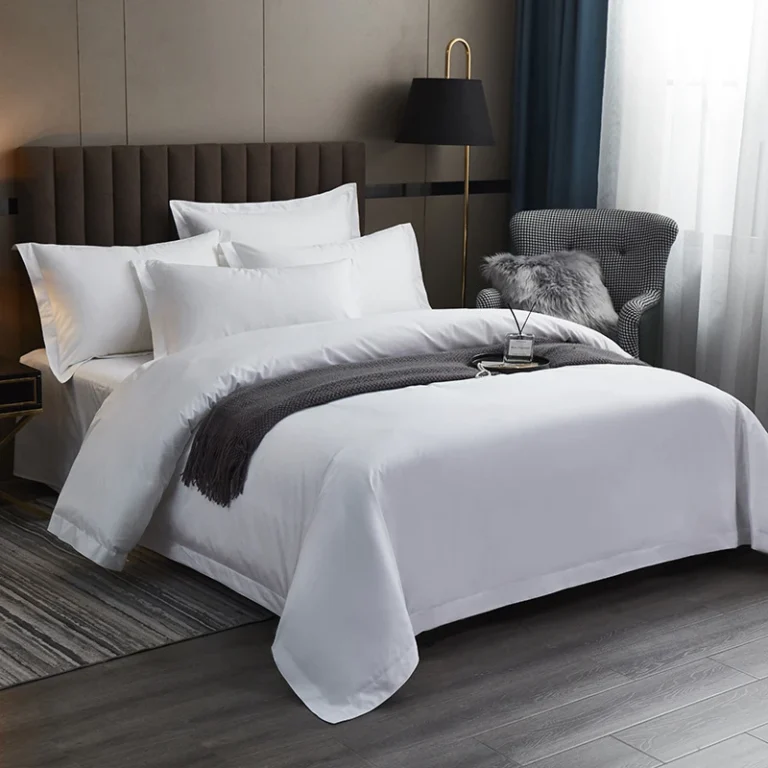
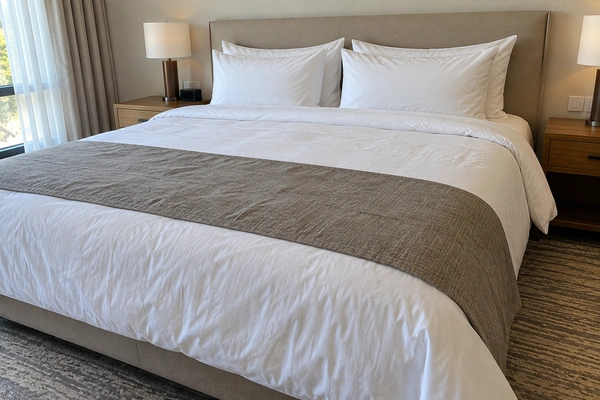
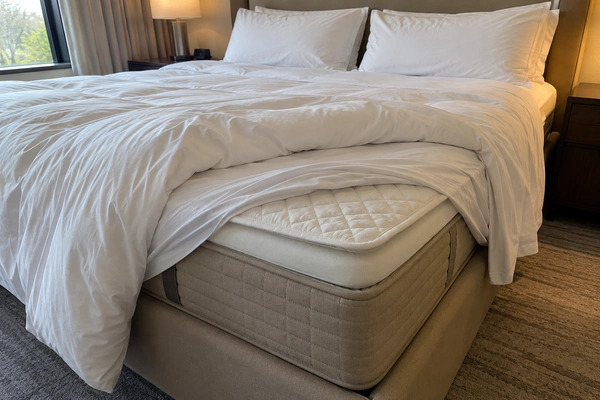
Most five-star hotel beds include a fitted or flat bottom sheet, a top sheet or duvet cover, pillowcases, a duvet insert, several pillows, a mattress protector, a waterproof barrier, and a mattress topper. Hotels select each layer according to climate, brand positioning, laundering conditions, and guest expectations.
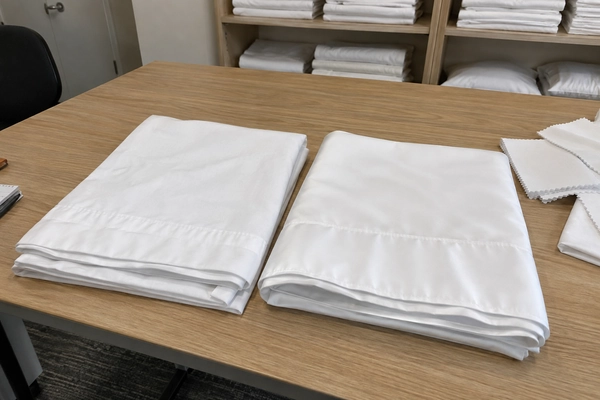
The core bed linen layers
I usually divide a hotel bed into three procurement categories:
-
Guest-contact linens
- Bottom sheet
- Top sheet, where the hotel uses one
- Duvet cover
- Pillowcases
- Decorative shams or runners
-
Filled bedding
- Duvet or comforter
- Sleeping pillows
- Decorative pillows
- Mattress topper
-
Protective products
- Mattress protector
- Waterproof mattress encasement or barrier
- Pillow protectors
- Duvet protectors, where required
Most luxury hotels prefer 100% cotton bed linen because guests recognize its softness and breathability.[^1] Cotton also provides the crisp appearance associated with an upscale hotel room. CVC fabric, which contains a higher proportion of cotton blended with polyester, can improve wrinkle resistance and control cost. However, I see it less often in high-end properties where natural hand feel is a priority.
How the layers affect guest comfort
Each bedding layer performs a different job. The sheet controls the immediate skin feel. The duvet affects warmth and weight. The pillow controls neck support. The topper changes pressure relief, while the protectors help prevent sweat, spills, and contaminants from reaching expensive inner products.
| Bedding component | Main purpose | Common luxury-hotel preference |
|---|---|---|
| Sheets and covers | Comfort and appearance | 100% cotton, smooth sateen or crisp percale |
| Duvet insert | Warmth and loft | Goose down or a quality down alternative |
| Pillows | Head and neck support | Multiple firmness options |
| Mattress topper | Pressure relief | Feather, down-alternative, foam, or fiber |
| Mattress protector | Hygiene and surface protection | Breathable, washable construction |
| Waterproof layer | Liquid protection | Quiet membrane with controlled heat retention |
| Pillow protector | Extends pillow life | Zippered or envelope closure |
I always recommend testing these products together. A soft sheet cannot compensate for a noisy waterproof layer. Likewise, a premium duvet may feel uncomfortable if its cover is too heavy or its size restricts loft.
> A luxury hotel bed succeeds when every layer supports comfort, housekeeping efficiency, and asset protection.
What Thread Count Is Used in 5 Star Hotel Bedding?
Thread count attracts attention because buyers can compare it quickly. However, an inflated number can hide weak yarn, poor finishing, or a counting method that includes individual plies. I never use thread count as the only measure of 5 star hotel bedding quality.
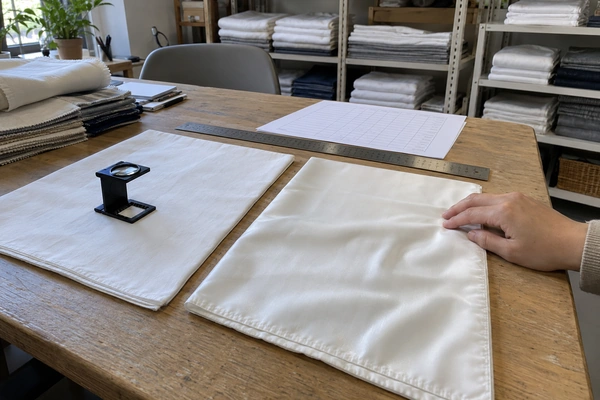
Five-star hotels commonly purchase sheets from approximately 350 to 600 thread count, although specifications vary by region and hotel group. European luxury properties often request 400 TC or above, while some Middle Eastern projects request constructions such as 80s × 120s yarns and stated counts of 600 TC or higher.
Regional specifications vary
Based on the international hotel projects we have supported, I see clear differences in common purchasing specifications. These are market patterns, not universal hotel-rating requirements.
| Region | Common specification pattern | Procurement considerations |
|---|---|---|
| Europe | Often 400 TC and above | Natural feel, refined finishing, and laundering performance |
| Middle East | Frequently 600 TC or premium fine-yarn constructions | High-luxury positioning and smooth sateen finishes |
| South Asia | Some five-star projects use around 350 TC | Climate, budget, and local laundry capacity |
| Africa | Specifications can range widely, including around 350 TC | Import logistics, replacement cycles, and laundry conditions |
| Global hotel chains | Brand-specific standards | Approved samples and documented construction are essential |
The hotel’s location does not determine quality by itself. A 350 TC sheet made with stable yarn and good finishing can outperform a poorly constructed product labeled 600 TC. Buyers should also ask whether the number represents a recognized thread-count method.
What does 80s × 120s mean?
Yarn-count descriptions such as 80s × 120s generally identify the fineness of warp and weft yarns. Higher yarn counts usually indicate finer yarn, but the meaning depends on the cotton-count system and fabric construction.[^2] Fine yarn can create a lighter, smoother fabric, yet it also requires controlled spinning, weaving, finishing, and laundering.
I suggest requesting the following information:
- Warp and weft yarn counts
- Warp and weft thread density
- Single-ply or multi-ply yarn construction
- Finished fabric weight in grams per square meter
- Weave type, such as sateen or percale
- Dimensional stability after washing
- Pilling and tensile-strength results
- Laundering temperature recommendations
Sateen or percale?
I find that many premium hotels choose cotton sateen because it has a smooth surface and subtle sheen. Sateen can make high-thread-count sheets feel luxurious, although it may retain more warmth.
Cotton percale has a crisp, matte character. Its breathable structure can suit warm climates and guests who prefer a cooler bed. Neither weave is automatically better. The hotel should evaluate the fabric against room temperature, laundry chemistry, drying methods, and target guest experience.
For Hotelier’s own programs, our business context includes self-developed and self-woven fabrics that have been adopted by Marriott projects. We state that selected linen constructions can withstand up to 280 commercial wash cycles under specified conditions. I still advise buyers to verify this performance through approved samples, test reports, and a wash trial using their actual laundry process.
What Duvets and Pillows Complete 5 Star Hotel Bedding?
Sheets create the first impression, but filled bedding often determines whether a guest sleeps comfortably. Poor filling can flatten, clump, overheat, or release fibers. I therefore evaluate duvet and pillow specifications with the same care that I apply to visible hotel linen.
Luxury hotels commonly use goose-down duvets, feather-and-down blends, or premium synthetic alternatives. Many high-end projects specify at least 70% goose down for a lofty duvet, but no single percentage defines five-star status worldwide. Hotels should match fill power, weight, warmth, and allergen policies to their application.
Goose down and feather content
Down consists of soft clusters that trap air, while feathers contain quills and provide more structure.[^3] A duvet with a higher down percentage usually feels lighter and loftier for the same warmth. A feather-heavy product may feel denser and can cost less, but it may also be less suitable for guests seeking a soft, floating sensation.
Our luxury hotel customers often request goose-down content above 70%. However, I treat that figure as a common premium procurement specification rather than a universal five-star classification rule. Hotel ratings depend on the country, rating body, and property type.[^4]
Buyers should compare more than the down percentage:
- Fill power: Indicates the loft of down under a defined test method.[^5]
- Fill weight: Shows how much filling is placed inside the product.
- Down-to-feather ratio: Affects softness, structure, and price.
- Construction: Baffle-box designs can reduce cold spots.
- Shell fabric: Downproof cotton helps limit filling leakage.
- Cleanliness: Buyers should review relevant test documentation.
- Traceability: Responsible sourcing records may be important to the brand.
- Care method: Some products require specialist cleaning.
Down alternatives
I recommend a quality synthetic duvet when the hotel prioritizes easier maintenance, allergy policies, or lower replacement cost. Modern microfiber and hollow-fiber fills can provide good loft, although their heat and moisture behavior can differ from natural down.
| Duvet type | Main advantage | Main limitation |
|---|---|---|
| High-down-content duvet | Light, lofty, and warm | Higher cost and specialized care |
| Feather-and-down blend | Balanced structure and price | Heavier feel and possible quill sensation |
| Microfiber alternative | Consistent and easier to maintain | May retain more heat |
| Hollow-fiber duvet | Economical and washable | Loft may decline with repeated laundering |
Hotels often provide more than one pillow
A five-star bed commonly includes several pillows because one firmness level cannot suit every guest. I have seen hotel specifications combine soft down pillows with firmer feather, microfiber, or foam options.
A practical pillow program may include:
- One soft pillow for stomach sleepers
- One medium pillow for general use
- One firm pillow for side sleepers
- Hypoallergenic alternatives on request
- Specialty foam or ergonomic pillows through a pillow menu
I advise buyers to use pillow protectors even when the pillowcase is changed after every stay. Pillow cores cost much more than pillowcases, and they are harder to clean without changing their shape.
Why Does 5 Star Hotel Bedding Need Mattress Protection?
Luxury hotel mattresses and filled products represent a substantial investment. A single spill, contamination event, or unresolved stain can create replacement costs and room downtime. In our hotel supply work, I see protection layers treated as essential components rather than optional accessories.
Five-star properties usually protect the bed with a washable mattress protector, a waterproof barrier or encasement, and pillow protectors. Many also use a mattress topper for comfort. The protector and waterproof layer preserve the mattress, while the topper adjusts softness and pressure distribution.
Protector, waterproof layer, and topper are different
Buyers sometimes use these terms interchangeably, but each product has a distinct role.
| Product | Primary function | Typical construction |
|---|---|---|
| Mattress protector | Hygiene and light surface protection | Quilted cotton, polyester, or blended fabric |
| Waterproof protector | Blocks liquids | Fabric laminated with a waterproof membrane |
| Mattress encasement | Covers all mattress sides | Zippered, often waterproof or allergen resistant |
| Mattress topper | Adds comfort and pressure relief | Fiber, feather, down, foam, or latex |
A mattress topper does not always provide reliable liquid protection. Likewise, a waterproof protector does not necessarily improve comfort. I recommend specifying both functions separately unless laboratory data and samples prove that one product performs both jobs.
What should buyers test?
The most common procurement mistake is choosing the highest waterproof rating without evaluating guest comfort. An impermeable layer may create heat, noise, and a plastic-like sensation. A better hotel product should balance liquid resistance with breathability and quiet movement.
I suggest testing:
- Liquid resistance: Confirm whether the product withstands common spills.
- Noise: Move on the made-up bed and listen for rustling.
- Breathability: Assess heat and moisture during an overnight trial.
- Fit: Check whether the skirt or elastic remains secure.
- Wash stability: Wash and dry the product repeatedly before approval.
- Membrane durability: Inspect for delamination, cracks, or hardening.
- Housekeeping time: Measure how quickly staff can remove and refit it.
Protective layers also need an appropriate replacement schedule. Hotels should not assume that a waterproof membrane remains effective indefinitely. High drying temperatures, aggressive chemicals, and repeated folding can damage laminated materials.
In our experience supplying hotels in different countries, customers pay close attention to mattress and pillow protection because the core products cost much more than replaceable linen covers. I recommend that buyers calculate cost per occupied room night, not only the unit price. A slightly more expensive protector may reduce mattress replacement and room closure costs.
How Should Buyers Choose a 5 Star Hotel Bedding Supplier?
A sample can look excellent in a meeting room but perform poorly after commercial laundering. Buyers face greater risk when a supplier cannot reproduce color, dimensions, stitching, or fabric hand across repeat orders. I evaluate the manufacturer’s quality system as closely as the initial product.
Buyers should choose a 5 star hotel bedding supplier through sample approval, wash testing, factory assessment, specification control, and reference checks. They should verify cotton composition, yarn construction, dimensions, shrinkage, colorfastness, seam quality, fill claims, testing documents, production capacity, and replacement-order consistency before signing a long-term agreement.
Create a measurable specification sheet
I recommend avoiding vague terms such as “luxury cotton” or “hotel quality.” A useful specification should define measurable requirements.
For bed linen, the document can include:
- Fiber composition and allowed tolerance
- Yarn count and ply
- Thread density and stated counting method
- Weave and finished weight
- Finished dimensions after washing
- Maximum shrinkage limits
- Whiteness or color standard
- Stitch count and seam construction
- Label position and care symbols
- Packaging and carton quantities
- Acceptable quality limit, or AQL
- Commercial laundering method
For duvets and pillows, buyers should also specify filling composition, fill weight, construction, shell fabric, leakage limits, and packaging recovery time.
Run a realistic wash trial
I advise hotels and laundry rental companies to test at least several production-representative pieces. A short domestic wash does not reproduce commercial conditions. The trial should reflect actual water hardness, detergent, bleach policy, extraction force, drying temperature, and finishing equipment.
The buyer should measure:
- Dimensions before and after washing
- Appearance after repeated cycles
- Seam twisting
- Pilling and surface abrasion
- Stain-release performance
- Fabric strength
- Duvet-cover fit after shrinkage
- Housekeeping feedback
- Guest-comfort feedback, where possible
Verify supplier claims and documents
Hotelier was established in Jiangsu in 1999. According to our business records, our factory has approximately 300 employees, covers more than 40,000 square meters, and has worked with over 30,000 hotels. Our supplied business context includes projects for Hilton, Marriott, InterContinental, Ritz-Carlton, Four Seasons, Banyan Tree, Crowne Plaza, and Mandarin Oriental.
I present those details as supplier background, not as a substitute for buyer due diligence. Procurement teams should independently verify references, current authorization status, audit reports, test documents, production capacity, and any claimed certification. They should also ask a qualified textile, laundry, fire-safety, or hospitality professional to review application-specific requirements.
A dependable supplier should make repeat purchasing easy. The supplier should retain approved samples, document revisions, control raw materials, and communicate lead times clearly. Those capabilities are especially important for hotel groups, distributors, short-term rental operators, and linen rental companies that need consistent replenishment across many locations.
Frequently Asked Questions
Do all five-star hotels use 600 thread count sheets?
No. I see five-star hotel sheets ranging from around 350 to 600 TC and above. Regional preferences, brand standards, climate, and laundry conditions influence the final specification. A well-made 350 or 400 TC fabric can perform better than a weak product marketed with an inflated thread count.
Do five-star hotels use 100% cotton bedding?
Most luxury properties prefer 100% cotton for sheets, duvet covers, and pillowcases because it feels breathable, familiar, and comfortable. Some hotels use CVC or other cotton-polyester blends to reduce wrinkling, accelerate drying, or control cost, but those blends are less common in premium guest-contact linens.
Do five-star hotels use goose-down duvets?
Many five-star hotels use goose-down or feather-and-down duvets. In our supply experience, premium projects often request goose-down content above 70%. However, synthetic alternatives are also common when hotels prioritize allergy management, washability, consistent performance, or lower replacement costs.
What is the best weave for luxury hotel sheets?
I recommend sateen when a hotel wants a smooth hand and subtle sheen. I recommend percale when the property wants a crisp, cool, and breathable feel. The best choice depends on climate, room temperature, laundering methods, brand style, and guest expectations.
How long should five-star hotel bedding last?
Service life depends on fabric construction, rotation levels, washing chemistry, stain treatment, drying temperature, and handling. Some Hotelier linen constructions are specified for up to 280 commercial washes under controlled conditions. Buyers should confirm durability through documented test conditions and an on-site laundry trial.
Conclusion
5 star hotel bedding usually combines 100% cotton sheets, carefully selected duvets and pillows, and multiple mattress-protection layers. Thread counts commonly range from about 350 to 600 or higher, but construction quality and wash performance matter more than one headline number. I recommend that every buyer compare complete specifications, test samples in the actual laundry, and verify supplier documents before ordering. Contact Hotelier to discuss a tailored hotel bedding package, request samples, or develop a wash-tested specification for your property or distribution market.
[^1]: "Stay Cool: Top Fabrics to Wear to Survive the Summer Heat", https://news.gatech.edu/news/2024/07/02/stay-cool-top-fabrics-wear-survive-summer-heat. Textile-comfort studies associate cotton fabrics with moisture absorption and tactile properties relevant to bedding comfort; however, these material findings do not by themselves demonstrate that most luxury hotels specify 100% cotton. Evidence role: general_support; source type: paper. Supports: Comparative textile research should support cotton's moisture-related comfort and tactile properties relative to common polyester-rich fabrics.. Scope note: Material-performance research supports the stated rationale but not the claimed prevalence among luxury hotels. [^2]: "Units of textile measurement", https://en.wikipedia.org/wiki/Units_of_textile_measurement. In the indirect English cotton-count system, a larger count denotes more standard-length hanks per unit mass and therefore a finer yarn; this numerical relationship is not universal because direct systems such as tex increase with yarn mass per unit length. Evidence role: definition; source type: education. Supports: A textile reference should distinguish indirect cotton count from direct linear-density systems and explain how count relates to yarn fineness.. [^3]: "Down feather", https://en.wikipedia.org/wiki/Down_feather. Down is characterized by three-dimensional clusters with radiating filaments that retain air, whereas feathers possess a central shaft and vane, a structural distinction that helps explain down's high loft-to-weight insulation. Evidence role: mechanism; source type: research. Supports: A scientific or standardized source should define down clusters and feathers and explain the role of trapped air in thermal insulation.. [^4]: "Hotel rating", https://en.wikipedia.org/wiki/Hotel_rating. International reviews of hotel classification describe multiple national and private rating systems with differing criteria and governance, confirming that a five-star designation is not based on one universally applicable bedding specification. Evidence role: historical_context; source type: institution. Supports: An international tourism source should document the coexistence of national, regional, public, and private hotel-classification systems.. [^5]: "Fill power", https://en.wikipedia.org/wiki/Fill_power. Standard down-testing methods define fill power as the volume occupied by a specified mass of conditioned filling under prescribed conditions, making it a measure of loft rather than the total amount of filling in a duvet. Evidence role: definition; source type: institution. Supports: A recognized down-testing standard should define fill power as the volume occupied by a specified mass under controlled preparation and measurement conditions.. Scope note: Results are comparable only when the same conditioning and test method are used.